
While the jingoistic side of me wished Team USA had won the hockey match for the gold medal today, it's better in the long run that Canada won.
It's a matter of perspective. See, there is no medal in any sport that means as much to the American zeitgeist as this one did to Canada. Ice hockey is Canada's only notable athletic endeavour and more than any singular event, an ice hockey tournament is the only measure of Canada's athletic greatness. On the other hand, basketball tournaments are pretty much a joke for the US in the modern era, we get silvers in ice hockey even though the vast majority of Americans live in areas where it isn't a realistic sport, and arguably most of our better athletes go into American football. Heck, in the second-tier sport of soccer, we made the quarter-finals of the last World Cup. Admittedly, baseball isn't America's strong suit at the moment.
On the other hand is Canada, a regular doormat in international tournaments (didn't qualify for the soccer World Cup, 2008 Beijing Olympics in basketball, etc.). The "Canadian" Football League survives on NFL sufferance and funding. Canada doesn't have the chops to handle more than a single major league franchise in pro baseball or basketball. This is truly all they have. Add in the fact that in a nation as culturally cleavaged as Canada, where one-fifth of the people live in a Quebecois culture which is more distinct than anything else in North America, and hockey is the only national touchstone the nation has. This wasn't an athletic win...it was amusingly close to a vindication of the Canadian experiment.
America wanted this gold medal.
Canada desperately, cryingly needed it. Good for them.
That said, I'm still more pissed about the Celtics losing at home to the New Jersey Nets.
PS: Anybody who watched the closing ceremony knows what I mean. A somewhat limp presentation from Sochi, Russia was followed by a tedious 45 minutes about what it means to Canadian, and Canadian iconography. If there's a culture in the world that cries out for legitimacy more than English-Canadian culture, I don't know it. I'd really have to rate this as the worst closing ceremonies I've ever seen.
Showing posts with label nationalism. Show all posts
Showing posts with label nationalism. Show all posts
Sunday, February 28, 2010

Wednesday, July 30, 2008
Modern China: More Diverse than You Might Think
With the Summer Olympics fast approaching, the amount of amateur punditry concerning the Land of the Dragon is going to skyrocket (indeed, talk of China is all over BMG right now). And while I'm not expert, there is one facet of Chinese culture and politics that I think is important to keep in mind.
Even though it's different and distant, China is not a monolith.
The overwhelming challenge for any Chinese government of any ideology is simply to keep the country together. While we hear a great deal of Tibet, China is a far more diverse place than I think many Americans realize.
A Xinhua news article quoted here posits that nearly 1 of every 6 Chinese citizens do not speak a dialect of Chinese. There are significant differences between the dialects common around Shanghai, Beijing, and Honk Kong -- enough to make mutual comprehension touch-and-go. Hakka is a dialect spoken by 34 million Chinese, and is essentially incomprehensible to Mandarin speakers.
I lead with language because that is the strongest building block of national identity in the modern age, but strong regional divergences in economic prosperity, vocational concentration, and educational availability also haunt China. Not to mention the sheer distance of the third largest state land area in the world.
Thus, I don't think Chinese reaction to regionalist movements in China is based on simple authoritarianism. China is far less diverse than many other countries (the Han ethnic group form 92% of the population), but it is unwieldy due to size, differentiation, and history. While Tibet does have the strongest legal case for independence, there are enough linguistic, historical, or even religious differences within the country to nurture dozens of sovereignty movements, should such a trend occur. Hainan is a culturally unique place, Manchuria has a history of autonomy, entering the 20th century as an independent state...and that doesn't even touch on Taiwan or Xinjiang.
As Tibetan independence would be a problem, so too would formal independence in Taiwan would also start the avalanche. I submit that the Chinese are in no real hurry to try to assimilate Taiwan...rather, they fear the precedent that would be caused if their sovereignty were officially acknowledged. This is the same tendency that underlay the joy in Chinese regaining of Hong Kong and Macau -- and its smooth assimilation.
I think a key parallel is to Moscow's rough treatment of the Baltic Republics in the late 1980s, particlarly the insistent sovereignty movement of Lithuania. They were right, of course...as soon as the center began to fall, every single republic sprung from Moscow's grasp almost instantly.
To be clear, I am not rationalizing the anti-democratic tendencies of the Chinese regime. However, I think there are elements beyond popular suppression at work. The government has long used nationalism as a glue to bind together the country, and it seems to be succeeding. While many of the marches outside of Japanese and Korean embassies regarding historization of World War II are government-staged, the anger of Chinese counter-protesters along the Olympic torch relay were probably spontaneous.
The currently constituted People's Republic of China is as large a conglomeration of land under Chinese rule as has been achieved in history. Maintaining requires a dedication to the current borders that supersedes interest in democracy, and I would say, Communism. Far worse than the label of the American president who "lost China", I would say, would be the person known as the Chinese Premier who lost his own country.
Monday, January 21, 2008
Interesting People: Louis Riel
"Is he crazy?" is such a common rhetorical crutch widely bandied about, but not in any serious way. It's just a way of questioning somebody's judgment. Once in a while, though, somebody comes along who does things in such a strange, such a spectacularly confusing fashion, that it's necessary to append "Seriously. I mean it...is there any chance that he's actually, you know, nuts?" Louis Riel was such a man.
Part would-be Messiah, part criminal, part demagogue, Louis Riel was the greatest "troublemaker" of Canada's colonization of its West. Whereas the "Wild West" is enshrined in the United States as an often violent, anything-goes messy expansion, Canada's settlement is typified by the smiling Mountie keeping everything in order.
Louis Riel the exception. He was the leader of the Métis, the Canadian equivalent of Mexican Mestizo, individuals with a blended Native American and White background. In the case of Canada, the French had long held better, though stained, relations with Native Americans. Thus the Métis were Anglo-Canadians' worst nightmare: Native Americans who spoke French.
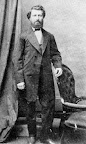 Riel (looking decidedly uncrazy at right) would wind up the spokesman and face of the many Native American grievances with Canada as it expanded. Though slightly more friendly than Americans at the time, the Canadians (particularly the English-speakers in Ontario) thought little of removing Native Americans from "their" land. Riel started in friendship, helping negotiate the Manitoba Act whereby the area acceded to the Canadian federation as a province (their equivalent of statehood).
However, Riel soon protested against the swift Anglicization of the area, as well as the near-automatic shafting of the land's first settlers. Native and White Manitobans alike loved the firebrand, voting him into Parliament three times, though hostility in the capital prevented him from ever taking his seat in Ottawa. Frontier-urban tensions boiled over as a small force led by Thomas Scott incursed into Manitoba to extend that benevolent Canadian supervision. Unhappy Métis surrounded and captured the force, eventually executing Scott. A warrant was duly issued for murder, and Mounties sent out to arrest Riel. Riel smartly skipped the border into what is now Montana.
He didn't stay in the US long, though, responding to requests from leaders of modern-day Saskatchewan to represent their concerns about the encroaching Canadian government. His entreaties utterly ignored, Riel chose direct action and employed his considerable charisma to gather a fighting force (One quote: "We are men, free and spirited men and we will not allow even the Dominion of Canada to trample on our rights"). This 1885 revolt, called the Northwest or Red River Rebellion failed, which ultimately failed as Native American rebellions tended to do. Riel surrendered to the Canadian forces and put on trial. Six white, Anglophone Protestants found him guilty but recommended mercy. The judge sentenced him to death, and Riel was hanged in November 16, 1885.
 Riel's hanging was the match-strike of Quebec nationalism, which has mutated and evolved over time, but never truly gone away. The ever-sensitive Prime Minister of Canada John MacDonald announced "He shall hang, even though every dog in Quebec barks in his favour." Honoré Mercier, one the first Quebec leader to espouse nationalism, road this tide into office as Premier of Quebec shortly thereupon. Over a century later in 1995, sovereigntist member of Canadian Parliament Suzanne Tremblay (left) from Quebec sponsored a motion to repeal his conviction. The bill failed.
Oh, the crazy part? Well, Riel perceived himself increasingly in Messianic terms. Receiving an education from Jesuits, he began to identify himself with the travails of Jesus. He interrupted a sermon to begin issuing "divine pronouncements" and was eventually barred from the Catholic Church. This messages were key in gathering the troops for his failed rebellion. A jester would venture that Riel was truly the first Mormon, as he said at one point saying "Do you know these people of mine are just as were the children of Israel, a persecuted race deprived of their heritage. But I will wrest justice for them from the tyrant. I will be unto them a second David." Followers abandoned the Catholic Church widely and followed Riel into this fight in a parallel to the "Ghost Dance" movement among Lakota and other Native Americans.
Part would-be Messiah, part criminal, part demagogue, Louis Riel was the greatest "troublemaker" of Canada's colonization of its West. Whereas the "Wild West" is enshrined in the United States as an often violent, anything-goes messy expansion, Canada's settlement is typified by the smiling Mountie keeping everything in order.
Louis Riel the exception. He was the leader of the Métis, the Canadian equivalent of Mexican Mestizo, individuals with a blended Native American and White background. In the case of Canada, the French had long held better, though stained, relations with Native Americans. Thus the Métis were Anglo-Canadians' worst nightmare: Native Americans who spoke French.
 Riel (looking decidedly uncrazy at right) would wind up the spokesman and face of the many Native American grievances with Canada as it expanded. Though slightly more friendly than Americans at the time, the Canadians (particularly the English-speakers in Ontario) thought little of removing Native Americans from "their" land. Riel started in friendship, helping negotiate the Manitoba Act whereby the area acceded to the Canadian federation as a province (their equivalent of statehood).
However, Riel soon protested against the swift Anglicization of the area, as well as the near-automatic shafting of the land's first settlers. Native and White Manitobans alike loved the firebrand, voting him into Parliament three times, though hostility in the capital prevented him from ever taking his seat in Ottawa. Frontier-urban tensions boiled over as a small force led by Thomas Scott incursed into Manitoba to extend that benevolent Canadian supervision. Unhappy Métis surrounded and captured the force, eventually executing Scott. A warrant was duly issued for murder, and Mounties sent out to arrest Riel. Riel smartly skipped the border into what is now Montana.
He didn't stay in the US long, though, responding to requests from leaders of modern-day Saskatchewan to represent their concerns about the encroaching Canadian government. His entreaties utterly ignored, Riel chose direct action and employed his considerable charisma to gather a fighting force (One quote: "We are men, free and spirited men and we will not allow even the Dominion of Canada to trample on our rights"). This 1885 revolt, called the Northwest or Red River Rebellion failed, which ultimately failed as Native American rebellions tended to do. Riel surrendered to the Canadian forces and put on trial. Six white, Anglophone Protestants found him guilty but recommended mercy. The judge sentenced him to death, and Riel was hanged in November 16, 1885.
Riel's hanging was the match-strike of Quebec nationalism, which has mutated and evolved over time, but never truly gone away. The ever-sensitive Prime Minister of Canada John MacDonald announced "He shall hang, even though every dog in Quebec barks in his favour." Honoré Mercier, one the first Quebec leader to espouse nationalism, road this tide into office as Premier of Quebec shortly thereupon. Over a century later in 1995, sovereigntist member of Canadian Parliament Suzanne Tremblay (left) from Quebec sponsored a motion to repeal his conviction. The bill failed.Oh, the crazy part? Well, Riel perceived himself increasingly in Messianic terms. Receiving an education from Jesuits, he began to identify himself with the travails of Jesus. He interrupted a sermon to begin issuing "divine pronouncements" and was eventually barred from the Catholic Church. This messages were key in gathering the troops for his failed rebellion. A jester would venture that Riel was truly the first Mormon, as he said at one point saying "Do you know these people of mine are just as were the children of Israel, a persecuted race deprived of their heritage. But I will wrest justice for them from the tyrant. I will be unto them a second David." Followers abandoned the Catholic Church widely and followed Riel into this fight in a parallel to the "Ghost Dance" movement among Lakota and other Native Americans.
Thursday, December 20, 2007
Belgium Held Hostage: Resolved?
I have in the past posted some thoughts on the, um, situation in Belgium. Previous posts explain why Belgium hasn't had a federal government in nearly 200 days.
Today, I'll talk about the way out...sort of.
The "solution" is to punt. Current "outgoing" prime minister Guy Verhofstadt will remain PM until March 23rd, at which point presumptive PM Yves Leterme will take over. Mind you, possible coalition partners are starting to realize that this "plan" doesn't resolve their objection to Yves Leterme as Prime Minister, rather it delays their reckoning. In the article linked to, one Flemish party leader states in what I imagine is a "hey...wait a minute..." voice that there is no such thing as an interim government.
And that's the good news.
The bad news? Belgians are starting to parallel the break-up of Czechoslovakia in an important way. After the "Velvet Revolution" whereby Czechoslovakia became truly independent from the USSR/Russia, the country slowly and amicably broke into the two countries that exist today, the Czech Republic and Slovakia. This break-up was actually driven by the top (rare for nationalist problems), and the elites' inabilities to work together eventually filtered down to the people of the country, who slowly came to agree with the idea of separation.
Well, this may be happening here. Belgians' greatest expression of nationalism has been over the transfer of massive funds from the Dutch-speaking Flemish to the French-speaking Walloons. This is economic regionalization, common around the world (happens in the US and Canada as well), but now Belgium is experiencing divisions over language. In addition to dislike for Yves Leterme for his ignorance of Walloon culture, now it's leaking into beauty pageants. This lovely French-speaking contestant at the "Miss Belgium" pageant is whistled and booed for her ignorance of Dutch. Such a thing would be unheard of three years ago:
In the developed world, division over language use and knowledge is the most pernicious and intractable symptom of a real problem, and we are seeing it here.
Monday, November 19, 2007
Belgium held hostage: Day 161
35,000 people marched for more government! (for English coverage, try Flemish news service flandersnews). The situation alluded to earlier has worsened, and I explain in more detail why below...
 Belgium has two versions of federalism. One based on regions (in this map, Dutch-speaking Flanders in yellow, French-speaking Wallonia in red at bottom, and French-speaking Brussels is the red dot in the sea of yellow.)
Also, the country is divided into linguistic communities -- French, Dutch, and German (the blue stuff on the right). In an interesting experiment, these legislatures are non-territorial. A registered francophone living in Flanders votes for seats in the French-speaking parliament.
This is the loosest constitutional federalism in the developed world. In addition to such typical competences as education and language, these smaller units also have strong sway over justice and some departments of international relations (that's right -- the two larger sections of Belgium run largely independent foreign policies in some arenas).
This political bifurcation of Belgium has gone all the way to the political apparatus at this point. There is no national political party in the country as everyone -- Greens, Socialists, Liberals, etc., is divided into two groups that work together. So you have les socialistes and die socialistiche. French-speaking parties run only in French-speaking areas and vice versa.
While some parties worked more closely with their partner than others (Green MPs would even take their parliamentary oath in their second language), one could usually expect all Belgiane Liberals or all the Socialists to support a common candidate, giving that person a working coalition.

Until Yves Leterme came along. He is among the first whose career flowered during this divisive time. "Mr. Flanders" as he's known is a popular figure in Dutch-speaking Flanders...and unknown in Wallonia. So, when he introduces himself by, say, not knowing the French words to the Belgian national anthem and humming "Le Marsaiellaise" instead, well it's bad mojo. Imagine a New England presidential candidate ignorant of Jefferson Davis, Fort Sumter, and NASCAR all rolled into one. That's what we got with Yves. Oh, and he's ignorant of the French-based origin of the Belgian equivalent of July 4th. Video below for French-speakers:
Now the 40% of the Belgian political establishment that is French-speaking loathes him. About 40% of the Flemish-speaking establishment already detested him because of his take-no-prisoners climb to the top. It's tough to build a coalition when the top vote-getter was alienated two-thirds of the country. Their best hope for a prime minister is hated much more that tolerated.
What will happen next is open to question. The king (yes, they have one) has tried to bring people together to no avail. New elections would likely be a boon for the smaller nationalist parties. A sacrifice of Leterme is not impossible.
But have you heard about massive waves of starvation? Panic in the Belgian countryside? Of course not -- because it seems increasingly that the federal government plays the same role in Belgium as county government in Massachusetts -- nice to have but not horribly, necessary.
The geographical and linguistic communities handle most domestic chores. The Brussels-based Europe Union does monetary, financial and increasingly foreign policy (and the Belgian elite love the idea of the EU), and Brussels-based NATO directs what armed forces they have.
Whether this is the end of Belgium, stumbling to dissolution as did Czechoslovakia is possible. Unlikely says I, but possible. In any case, an interesting story...
Crossposted at the Bluest of the Blue: Blue Mass Group
Belgium has two versions of federalism. One based on regions (in this map, Dutch-speaking Flanders in yellow, French-speaking Wallonia in red at bottom, and French-speaking Brussels is the red dot in the sea of yellow.)Also, the country is divided into linguistic communities -- French, Dutch, and German (the blue stuff on the right). In an interesting experiment, these legislatures are non-territorial. A registered francophone living in Flanders votes for seats in the French-speaking parliament.
This is the loosest constitutional federalism in the developed world. In addition to such typical competences as education and language, these smaller units also have strong sway over justice and some departments of international relations (that's right -- the two larger sections of Belgium run largely independent foreign policies in some arenas).
This political bifurcation of Belgium has gone all the way to the political apparatus at this point. There is no national political party in the country as everyone -- Greens, Socialists, Liberals, etc., is divided into two groups that work together. So you have les socialistes and die socialistiche. French-speaking parties run only in French-speaking areas and vice versa.
While some parties worked more closely with their partner than others (Green MPs would even take their parliamentary oath in their second language), one could usually expect all Belgiane Liberals or all the Socialists to support a common candidate, giving that person a working coalition.
Until Yves Leterme came along. He is among the first whose career flowered during this divisive time. "Mr. Flanders" as he's known is a popular figure in Dutch-speaking Flanders...and unknown in Wallonia. So, when he introduces himself by, say, not knowing the French words to the Belgian national anthem and humming "Le Marsaiellaise" instead, well it's bad mojo. Imagine a New England presidential candidate ignorant of Jefferson Davis, Fort Sumter, and NASCAR all rolled into one. That's what we got with Yves. Oh, and he's ignorant of the French-based origin of the Belgian equivalent of July 4th. Video below for French-speakers:
Now the 40% of the Belgian political establishment that is French-speaking loathes him. About 40% of the Flemish-speaking establishment already detested him because of his take-no-prisoners climb to the top. It's tough to build a coalition when the top vote-getter was alienated two-thirds of the country. Their best hope for a prime minister is hated much more that tolerated.
What will happen next is open to question. The king (yes, they have one) has tried to bring people together to no avail. New elections would likely be a boon for the smaller nationalist parties. A sacrifice of Leterme is not impossible.
But have you heard about massive waves of starvation? Panic in the Belgian countryside? Of course not -- because it seems increasingly that the federal government plays the same role in Belgium as county government in Massachusetts -- nice to have but not horribly, necessary.
The geographical and linguistic communities handle most domestic chores. The Brussels-based Europe Union does monetary, financial and increasingly foreign policy (and the Belgian elite love the idea of the EU), and Brussels-based NATO directs what armed forces they have.
Whether this is the end of Belgium, stumbling to dissolution as did Czechoslovakia is possible. Unlikely says I, but possible. In any case, an interesting story...
Crossposted at the Bluest of the Blue: Blue Mass Group
Thursday, November 15, 2007
Belgium Held Hostage: Day 158
On June 10, 2007, the people of Belgium voted. After the votes were tallied, Belgians probably expected the politicians to, you know, form a government. Sometime soon. As in, before 2008.
Belgium is on its 158th day without a government. Why, well it's...complicated. Or if you prefer this in Belgian: compliqué/ingewikkeld.
Most of Belgium speaks Flemish Dutch, about a third of the country speaks French (a fraction speaks German, but they don't count). And never the twain do meet. No political party runs in both linguistic communities -- it's one or the other. So a man or woman can end up hugely famous in Flanders and be completely unknown in French-speaking Wallonia. Which makes it kind of awkward if you're that guy -- Yves Leterme -- and you want to be Prime Minister, and half of your putative government has barely heard of you. Throw in ignorance of your own country's national anthem in its secondary language, and you have yourself no government.
Meanwhile, the French and Dutch linguistic regions merrily continue to set their own budgets, run their own schools (free of the hillbilly attempts at federal interference we have here) and conduct their own foreign policies. That's right -- parts of Belgium can have different foreign policies. And above all that the European Union runs other things.
Maybe they don't need a Prime Minister, which is good -- they don't have one.
On the other hand, they do have excellent French Fries.
Mayonnaise required.
Subscribe to:
Posts (Atom)
