Showing posts with label history. Show all posts

Thursday, July 9, 2009

Power easy to get in Alaska

Becoming the governor of Alaska is starting to look pretty easy. Sarah Palin got elected on the strength of her experience "running" Wasilla and sitting on some government board. I thought that was a jump, but rapid and bewildering promotions are apparently part of Alaskan culture...Palin's legal successor is the guy who runs their prisons:

The state Legislature already confirmed a line of succession [to Governor Palin] under which corrections commissioner Joe Schmidt should be taking over as lieutenant governor.
Not the treasurer, head of the legislature, or attorney general. Not even the mayor of the largest city. No...the chief corrections officer takes over if the governorship of Alaska opens up. I'm not sure I'd want the state's chief jailer suddenly becoming the state's chief executive, but it's not my state. I'm not sure what role the lieutenant governor of Alaska then fills, but again -- it's not my state.

As for why this happened, my best guess is reminiscent of Britain's 1701 Act of Settlement. As the eighteenth century dawned, the reigning Princess Anne was getting in poor shape and thoughts turned to the next monarch of England. Such thinkers quickly realized that the 50 or so closest "heirs to the throne" according to law were all Catholic. Consequently, British succession law was hastily re-written to ensure that the next monarch was Protestant, whoever it would have to be. And...it had to be some German fellow who couldn't even speak English. That's right, when King George I of England acceded to the English throne, he couldn't speak English, which I imagine was awkward in all sorts of ways.

So, I can only guess the Alaska Legislature created their own cognate of the Act of Settlement in order to steer power away from Palin and her buddies. Instead, the chief jailer will now be running the state. Hopefully, it works out better for them.

Tuesday, April 21, 2009

On history: The Boston Tea Party

Coming off the previous week, it seemed everybody and his brother was trying to invoke the "spirit of the Boston Tea Party", whether it be pro-equality activists in Boston, or conservatives nationwide protesting the cutting of their tax rates, having an African-American president, or something. The BTP strikes a strong chord, it would seem -- it was also evoked in 2004 as Howard Dean opted out of spending restrictions at the height of his campaign. Continuing on a rather interesting discussion at BMG though, I have to admit that the whole BTA thing never much resonated with me. Exploring why is an interesting look at how to consider history.

As I alluded a while ago, historians usually place themselves along a spectrum with the "great men" idea on one extreme, and "longue durée" on the other. For centuries, the West was fixated by the "great men" idea that history was shaped by the Julius Caesars and Winston Churchills of the world. Strong personalities stood astride history, and leaping from one biography to another was the essential point of our story. In reaction, there arose first in France the idea of the longue durée school, which basically holds that history is the product of broad, slow-moving trends. To those historians, Caesar was not so much an extraordinary man as an above-average man at an extraordinary moment. Biographies aren't nearly as important as demographic data, and social movements. It's an intense debate that often gets emotional.

If you want to approach it from a geological parallel, longue durée measures tectonic shifts, while "great man" chronicles the earthquakes.

To take a "Great Man" view that powerful individuals shape history, you can make good book that had John Kerry been president in 2002, we'd not have invaded Iraq, a decision that set the course of a good piece of history for the next little while.

On the other hand, "longue durée" folks aver that Churchill was big in World War II, but he didn't create the American-British friendship himself, didn't move Britain off the coast of Europe...heck, he didn't even deliver one of "his" most famous speeches.

Over time, I do lean toward the longue durée way of thinking, and the Boston Tea Party is a great way to examine why. Granted, Great Men are needed for national holidays, statues, to put on money, and all the things that go into the building of an essential national mythology. Plus, it's much easier to write history textbooks and tv series that way -- all reasons why you can see some hysterical reactions to questioning anyone's national mythology. To see one such example as applies to the Boston Tea Party, look here.

One can't deny the aftermath of the protest...the British overreaction to the Tea Party, the Patriots' exploitation of that overreaction to spread colonial hostility to the British, and the adding of several more flakes to what snowballed into the American Revolution. What I can and will deny, however, is that there was anything special about the Boston Tea Party as such that created the moments and forces that eventually shifted the course of history, or that anything happened then and there that would not have happened elsewhere eventually. Basically, I hold that the forces at play would have pushed history forward whether it had been tea in Boston or tobacco in Hampton Roads, Virginia. We would have had an American Revolution, with or without the Boston Tea Party. Here's why...

  • Economic realities: The American colony was a money loser for the British, what with defending the transplants against Native Americans and the French. London wasn't going to long tolerate paying for it...but the colonists weren't about to pay for it themselves. Stalemate. This was the basis of the entire crisis, in my opinion. Sure, the lot of English-speakers muddled through during the Seven Years'/French and Indian War out of self-preservation against a common enemy, but this arrangement wasn't going to last long in peacetime.
  • Colonial overreaction: Charles Townshend was not the coolest-headed person to walk the Earth, and it was the package of punitive measures collectively remembered as the Townshend Acts that got many American colonials off the fence. He was backed by a bevy of similar-minded MPs in London who likely would have rotated him out of office had he gone soft on the colonials. Any series of protests anywhere in the 13 colonies would have evoked this overreaction -- it just happened to be the Boston Tea Party that sparked it in our history.
  • The pamphletting class: The BTA is remembered so fiercely thanks to a group of men who were creative and genial protesters skilled at advertising themselves. During the tea party, the "protesters" got the chuckling help of the ship's crew in finding and disposing of the tea, and it was an open secret who was involved. The Native American disguises were basically a joke. However, one thing the Patriots took seriously was the dissemination of their ideals, and the heroic light in which pamphleteers such as Thomas Paine would paint such events. It just happened that the Boston Tea Party was one such protest.
  • Decolonization: Colonies don't last. America may have been the first to rebel from modern European colonization, but the Hyksos had problems with their colonies four thousand years ago. The Americans quickly became too distant and different to remain partners in the British operation. Heck, even in much, much more recent times, colonies such as Algeria and Ireland rebelled despite being more closely intertwined with their colonizer. It just happens that here we're talking about Boston.


It was going to happen sometime, somewhere, and go from there. The Boston Tea Party was an amusing way to strike the match, but at the cost of about $1 million in today's dollars, not sufficient in isolation to create any problems. It may be useful to consider a modern parallel: imagine a secessionist Governor Perry destroyed $1 million of private property of a quasi-federal agency, say the Postal Service. Do you think Texas's ports would be blockaded, and specific taxes levied against it? No, Obama would sue, maybe suspend the transfer of some federal funds. Obama has a cooler head than Townshend, Texas is pretty much a break-even state for the feds, and it is completely integrated into the country to the point of supplying much of American socioeconomic, cultural, and political activity. Any Texas secessionist movement is too nascent to supply much in the way of propaganda in any case.

With American history full of movements that rely so much more on the greatness and courage of its people -- labor rights, women's rights, civil rights -- can't we retire the Boston Tea Party to the curiosity section of our history shelves? That way, we can at least invoke noble, pivotal protests for our latest pet peeves -- "Freedom (from Taxation) Rides" or "Seneca Falls II", anyone?

Sunday, November 9, 2008

What If...Andrew Jackson had Obeyed the Constitution?

Andrew Jackson has quite an historical record. On one hand, it was truly he that turned our country on the road to democracy. While he was president, it was the people's house literally...meaning they could even drop in for a snack. Then again, Jackson's record on slavery was as mixed as most of his contemporaries'. Not an abolitionist, him, but for what little it's worth Jackson did keep in mind the humanity of slaves more clearly than did many Americans. He also faced down the first movements of secession during the nullification crisis.

On the other hand. Hm. He perfected the "spoils system" of distributing government largesse to supporters. But that is a mere trifle compared to the horrific way that Andrew Jackson approached our land's first inhabitants. Having met Native Americans as combatants, Jackson stood against justice -- and his own Supreme Court -- in his zeal to persecute them. And the lowest moment, the dirtiest splotch on this docket, is the Trail of Tears.

The story itself is a fascinating one. The Cherokee of Northern Georgia had a settled, agricultural mode of existence in the early 19th century when settlers were seeking to expand the land under their control. The Cherokee had permanent transportation and educational infrastructure, representational government, a dedicated alphabet, and remarkable leaders such as John Ross and Sequoyah. When Andrew Jackson signed the Indian Removal Act, intended to appropriate the land under usage by the Cherokee, the Cherokee sued for relief in the American court system. The Supreme Court of the United States ruled that the Cherokee were a duly recognized sovereign nation, and should be treated as such. This is a remarkable and perhaps unique course of action -- to use the law of the occupier against it. It's tantamount to the Sudetens winning a judgment from the highest court in the Nazi government to cease the occupation.

In one of America's worst moments, Jackson reportedly reacted by declaring "John Marshall has made his decision; now let him enforce it!" Jackson then proceeded with actions to force the Cherokee to resettle in the barren wastes of what today is called Oklahoma. This compulsory migration has been remembered as the "Trail of Tears", during which about 4,000 Cherokee died. (Further reading on this sad episode can be found here, here, or here.)

So today I seek to investigate the question: what if Andrew Jackson had acceded to the Supreme Court and instructed the United States to recognize the Cherokee as an independent, sovereign nation?

Well, it wouldn't have been too large a nation, perhaps the northwesternmost sixth of Georgia, if that. At this time, it would have been surrounded by land entirely under American sovereignty. There are a couple nations surrounded entirely by others: Lesotho in South Africa being the largest one. Lesotho, however, gained independence in roughly the same process and period as South Africa; they avoided absorption due to the protection provided by a third party. Had Lesotho tried to take independence from South Africa rather than being given it at the same time as South Africa, I don't know how it would have gone.

So, too, with the land of the Cherokee. Despite this rather mature polity and approach, this country would have been literally surrounded by a hostile nation -- or more accurately, hostile neighbors from an indifferent nation. Though those lands would provide decent agriculture, there are little unique resources that I can imagine nurturing Cherokee independence. Cut off from neighbors, the highest that the Cherokee could hope for would be tolerance from their much more powerful neighbor. Though I can posit Jackson's acceptance of the legal and moral suasion of the Cherokee Supreme Court victory, I can't imagine that imperative would long remain. Eventually, even Oklahoma was claimed by American settlers; they'd not have given up on the Cherokee lands.

Furthermore, any Cherokee country would have had to survive the shifting sovereignties of the Confederate secession and Union capture. In essence, it would have had to receive tolerance from not only antebellum America, but also the CSA and the conquering Union army. Not too hard to imagine the Republicans occupying the Cherokee Nation had the Cherokee unduly supported their slave-owning neighbors in rebellion.

Finally, there would be assimilation. Intermarriage and movement would probably lead to a real demographic shift in Cherokee lands, and only careful policy would keep the population distinct from its neighbors. Granted, such a thing is possible (Gibraltar is very British, despite years of free interaction with Spain), but not always likely in such a small space.

I do sincerely want to find a case that with the "right" strategy, the First Peoples of the Americas could have stalled the European encroachment on these lands. I'm just not sure I can find one. Given the nearly inexorable determination to occupy the Americas, and the advantages which the occupiers enjoyed, it's tough to imagine the Cherokee enjoying long-term freedom from their legal victory, even had Andrew Jackson chosen to obey the Constitution.

Friday, June 27, 2008

Interesting People: Aristedes de Sousa Mendes

Some of my interests in history have come from odd questions for which I was never given a satisfactory answer in my formal studies. For instance, "why is so little attention paid to the largest land empire in human history?" (though that appears to be changing be changing).

Another is "how did Francisco Franco pull it off?" Really, this weak-voiced man emerges from a savage civil war to enjoy 34 years of rule and a natural death. Franco was a fascist (sorta), yet never joined in World War II and would come to receive significant American support during the Cold War. Among recent reads was this biography, Franco: A Concise Biography, which I mention mainly to urge you not to read it. It focuses on a lot of second-guessing and long-distance psychoanalysis of the man to the detriment of describing his career and accomplishments. It might be a good third or fourth read, but not an introduction.

The most interesting thing to me about Franco is his relationship with Hitler and Nazi Germany. Here was a man who gained power to some extent thanks to support from Germany, and especially Italy, during the Spanish Civil War. In response, he stiff-arms Hitler at the height of his power by remaining out of the war. He drags his feet, prevaricates, makes excuses, but above all stubbornly stays put. Clearly, he tilted in Hitler's favor, but never went the whole way. I find this especially amazing considering that Hitler got so much of what he wanted from everyone as long as possible: the Soviets supported him until he invaded the country, the Japanese threw in with this bunch of racists, the British and French turned over Austria and the Czechs...even America was less than aggressive in confronting the mongrel. Yet somehow, this watery, insecure bully said "no" when nearly anyone else had said yes.

Thus, my enthusiastic recommendation for the book Franco and Hitler, a comprehensive and engaging look at the relationship between Nazi Germany and the fascist Falange of Spain from genesis through victory to ultimate defeat. It's really a fascinating story, and I urge people to check it out. Short answer to the question above: Spain couldn't economically or militarily expect success if it entered the war, and he knew it deep down; Hitler also knew it, and had enough to do bailing out Italy that he didn't need Spain as well.

Anyway, it is in this book that I came across Aristedes de Sousa Mendes. Remember Aristedes? This is a post about Aristedes (Get it?). I think there is a strong urge to find heroism in bleakness, which explains the staying power of the stories of Oskar Schindler and Raoul Wallenberg. It was reading this book that I learned of this third man, Aristedes de Sousa Mendes. Similar to Schindler and Wallenberg, Sousa Mendes saved thousands of lives in all likelihood -- many of them Jews -- by following his conscience rather than his orders.

Sousa Mendes was a minor noble in Portugal, a nation that observed strict neutrality throughout the war, though increasingly tilted toward the Allies (the Portuguese government also had some of the clearest-eyed observations and analysis of the war in situ). Sousa Mendes was the diplomatic chief of post in Bordeaux, France when the Nazis invaded, and his response was to immediately start issuing transit visas for safe passage out of the war zone for refugees. Franco had closed the French-Spanish border, but was allowing entrance of people with a right to be in Spain, or to be in Portugal. Sousa Mendes wrote these visas guaranteeing entry into Portugal (and thus Spain) in defiance of orders from his superiors and by war's end he had issued over 20,000 visas that entitled the bearers to reach Portugal. Though Premier Antonio Salazar was pro-Hitler, fascist Portugal never enacted government policies meant to slaughter Jewish residents. Sousa Mendes had taken the decision to issue visas for Jews, no questions asked, in direct defiance to an order from Salazar that no visas be issued to Jewish refugees. Eventually, Sousa Mendes even we authorized others to issue these visas in his name. There were stretches of 48 hours where personnel signed and stamped visas before a crowd outside the consulate. (Also rescued by Sosusa Mendes' act was the scion of the Austro-Hungarian Emperor, whom Hitler had marked for death.)

Sousa Mendes didn't just issue papers...he made sure that they were respected. When the Portuguese consul in Bayonne, France (on the Spanish border) refused to vouch for these visas in contact to Spanish border agencies, Sousa Mendes went down there to personally change their policy. He also guided refugees to a border post without telephone contact, as they would be unaware of orders countermanding Sousa Mendes' visas. He literally lifted the gate to freedom for a crowd of refugees, and was stopped only when a higher official arrived on the spot and declared him mentally incompetent. Though Spain did not cover itself with glory during the war, at the least they did not expel any Jewish residents to feed Hitler's demands.

Unlike Wallenberg and too many others, Sousa Mendes escaped with his life. Upon his recall back to Portugal, though, he was forced out of the diplomatic service. His children were harassed, and two emigrated to the United States and fought in the army. Disabled by a 1945 stroke, and ignored by a government that decreed he be shown no charity, Sousa Mendes died poor. At his death, the only property still owned by the family was the burial plot in which he was interred.

Thankfully, he is starting to receive the recognition due for his heroism and his role in saving so many. The Portuguese government restored the mansion in which he once lived and returned it to his family last year. The only straw upon which to hold in the gale of hatred that is the Holocuast is that many people did do the right thing, regardless of cost.

I could not have acted otherwise, and I therefore accept all that has befallen me with love. -- Aristedes de Sousa Mendes

Monday, February 18, 2008

Weekend What-if: The Aztecs beat the Spanish

And to think I was going to do one of these every weekend! This will be an occasional series (see previous editions here and here exploring counterfactuals or "what-ifs" -- imagining the rollout of history had a key event gone in another direction. Today's, possibly this month's what-if concerns the near-miss which allowed Spain an easy conquest of what could have been their most formidable foreign threat: the Aztec Empire.

Along most conventional measures, the Aztecs were the best prepared civilization to resist the European encroachment. They had a somewhat mature polity, a series of city-states united around a center in loose empires similar to the Greek Delian and Peloponnesian Leagues. However, in the Aztec case, these groups were united rather than opposed in the so-called "Triple Alliance".

Aztec culture centered on the great city of Tenochtitlan, a metropolis centered on an island amidst an artificial lake (the legend of its founding is enshrined in the Mexican flag today). The picture at right from the University of Wisconsin shows a spacious, designed urban center. This thriving community had between 200,000 and 400,000 people today -- larger than the conurbations of Anchorage, Alaska or Utica, New York. They had systems of mathematics and writing. Aztec warriors were fearsome fighters who earlier had served as mercenaries. Their atl-atl spear thrower was quicker to "reload" than primitive Spanish muskets while just as deadly. Atl-atl javelins could pierce metal armor.

If you're not familiar with the story, Aztec religion told that in the past their chief god Quetzalcoatl had been incarnated and walked among them. Someday, that incarnation who went by the name Topiltzin would return to lead them again. This may sound familiar. Topiltzin would be recognizable through his odd appearance: a beard, blue eyes, and pasty skin. To an Aztec who'd only met Caribbean and Mesoamerican peoples, this was a bizarre description, equivalent to modern people awaiting a savior with antenna, chitlin armor, and the ability to emit sparks.

So, what did the Spanish leader and butcher Hernan Cortez look like when he stumbled into the region with his men? That's right: pale skin, beard, blue eyes. It went downhill from there. The amoral Spaniard exploited the Aztecs' mystifying worshipfulness of their lightly armed force to kidnap and eventually kill the Aztec emperor Montezuma. A nighttime raid on the leaderless and rudderless Aztec capital resulted in a hard-fought Spanish victory.
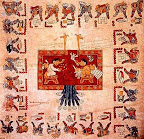
Don't get me wrong...there were other reasons for Cortez's victory. Their introduction of smallpox killed over three million people, a toll raised by deaths from measles and other diseases. The alliance between Spain and the Aztecs' enemies such as the Totonac also closed the tactical edge, as did Spanish armor and cannon. Nor we can we discount their horses, which would have represented the first encounter Aztecs had with beasts of burden, whose knowledge of large animals had heretofore topped out at jaguars. However, it's the decapitation of Aztec leadership and subsequent unsurety of the population that sealed the deal.


So what if Cortez had manifestly not been an Aztec god? What if he had darker skin and eyes? How would his force of some couple thousand men have made out?

To their advantage, their edges in weaponry, allies, and disease would remain the same had Cortez not received immediate adulation. Nor is it unthinkable that he'd have gained access to the Aztec leader anyway, going off the example of his partner in genocide Francisco Pizarro, who managed to kill off the Incan leader further southward. But saying that the Spanish don't have an "easy in" to Aztec civilization, what then?

Well, a straight Spanish v Aztec battle would have been resolved in the Aztecs' favor. The Aztecs had a 300 to 1 advantage, and the gap in weapons technology wasn't nearly large enough to compensate for that. Even with their allies, the Spanish could expect to be outnumbered a good 10 to 1 by the most vicious fighters in the Americas at the time. We know, among other things, that the Aztec fighters had little trouble routing the Spanish bridgehead in Veracruz.

Say the Spanish are killed. Wiped out by the Aztecs. Now the Aztecs know about the Spanish, but the Spanish remain ignorant of the Aztecs' existence and their horde of gold. While those diseases are still working on the Aztecs, there will now be a greater measure of preparation when the Spanish return.

For the Spanish would return. The tide of European exploration and conquest broke across American shores from Tierra del Fuego to Newfoundland. The true question is this: would an Aztec civilization forewarned of Spain's arrival yet weakened by Spanish diseases, have put up enough of a fight?

The Aztecs would have been hampered by the religious lens through which they viewed the world, and one can imagine an accelerated series of sacrifice and ritual in reaction to the Spanish' arrival, rather than further fortification and training. There is little reason that the Aztecs would figure out that they were opposing a determined enemy who sought assimilation, if not extermination.

However, given the difficult terrain of Mesoamerica and the Spanish's general ignorance of indigenous culture and politics (something at which the French and British proved skilled), conquest of the region could have come at a high price. Given that Spain's window of conquest closed before European technological advantages produced rifles and the like, the Aztecs could conceivably have fought a war of attrition whose costs were beyond Spain's liking. Their style was more suited to guerrilla campaigns, and the Spanish long had greater interests in resource extraction in this locale than in colonization.

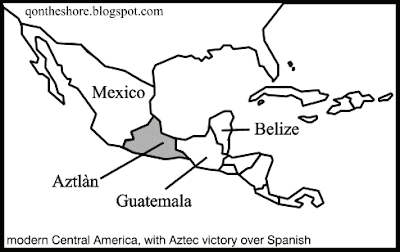
With a mature polity managing the war against Spain, the Aztecs could just maybe have waited until Spanish collapse at home. Assuredly, Spain would dominate the northern portion of modern-day Mexico, and likely a good part of Central America. A smaller rump state of Aztlàn (land of the Aztec) sandwiched between a larger English Belize and Spanish Mexico would have a shot after the wars of liberation.


Aztec animist beliefs would have poor chance of surviving the immersion in Catholicism, though the merger of state and church would not have been guaranteed in such a diverse society. For much of time, Aztlàn would retain an air of mystery and intrigue, the hemisphere's own Papua New Guinea. That uniqueness would make for an anthropologically and culturally fascinating contrast.

The subtraction of Aztlàn changes the divisions of the Spanish Empire, and thus the borders of their successor independent states (a map below is a theoretical approach to the area in modern times). A smaller and presumably weaker Mexico, deprived of Mexico City is even more subject to American whims. Texas's war of independence is yet more one-sided, and American domination of the Southwest is even more extensive. Pancho Villa is an unknown, and American troops enter World War One even less prepared, without the field experience gained from their pursuit of him.

The addition of an empowered indigenous ethnicity would severely alter the course of Central American history, though the process of economic and technological catch-up would leave it vulnerable to the same foreign meddling that the entire region experienced in the 20th century. A further divided Central America makes the Cold War "influence game" even worse on that region, and Aztlàn would likely alternate between vicious American-sponsored thugs and vicious Soviet-sponsored thugs.

The modern viewpoint of this part of the world is "Mexico and Central America", given their religious, linguistic, and historical common ties. Mexico of course has the largest economy and population, and thus the largest voice in the region. Without the large Mexico, Central America becomes less differentiated, and less an interest for American policy. Central America would be prone to enter South American orbit more, and the American focus would remain more strongly in the other hemisphere.


The Aztecs probably represented the best shot at aboriginal contest of European expansion. Given local antagonisms, it is doubtful that the Aztecs would lead a regional resistance to the Spanish incursion, but their strength in a fair fight would likely leave them outside the sphere of direct Spanish rule. A polity of the modern era rooted almost entirely in indigenous culture would not accrue most moral authority (one doesn't see such in Ethiopia or Thailand, also rare resistors to colonization), but would add variety to modern-day Latin America, and contribute to a de facto isolation of Mexico in its development from the Catholic Hispanic culture of Latin America.

Friday, November 16, 2007

Weekend What-if: A Mongol Invasion

On weekends, I'll endeavor to present a "what-if". I love alternate history...the attempt to extrapolate what would have happened if such-and-such had unfolded differently in history. Less alliterative but more to the point is the idea of a "near-miss". Despite the best attempts of the history education industry to present history as a procession of inevitable events, so much of what happened turned on surprising moments of fate.

This week's what-if: What If the Mongols Had Proceeded With Their Planned Invasion of Europe?

Free Image Hosting at www.ImageShack.us"What happened: 1242 -- the Mongols had brought the Muslim world (mainly Turks and Persians) to its knees, and pointed toward Europe. Whereas the Mongols were initially regarded by some Christians as allies in the struggle against Islamic states, this less tame Horde now became symbols of the devil. Under the leadership of the master strategist and general Sabutai (pictured here, from a Chinese print), the forces of the Mongol army streamed into Europe through Polish armies and were setting up outside of Vienna. When word of the khan's death arrived, however, the army turned, and raced back to the homeland, leaving destruction in its wake. The Mongols never returned. Christians naturally chalked it up to the intervention of God.

What would have happened?

First, leave behind any notion that anyone save the Mongols could have stopped the Mongols. Every single member of the army was mounted on horses that had raced through the steppes, and the typical Mongol boy received his first bow at 3. The European armed forces would have done little to stop the Mongols had they all been combined. Furthermore, a network of informants had given Sabutai a sense of the ragged relations in this appendage of Asia, and experience in Russia showed that the Mongols were quite able to turn possible allies against each other.

Following the typical image of Mongols in history, most people would theorize thusly: "horrible pillage and destruction by these crazed barbarians. Needless slaughter would have ruled Europe, and civilization would grind to a halt until the Mongols overextending themselves and being killed in turn."

Wrong. First off, the Mongols would occasionally destroy an entire city. They had little use for cities -- our best sources indicate that Chinggis (Genghis) Khan entered a building once in his lifetime. However, sacking a city was intended largely as a message. Sacking one city thoroughly could cause the next five to surrender, perhaps causing less bloodshed overall. Europe was pushing the limits of Mongol (Arctic, Egypt, Vietnam, and Japan) and it is unlikely that the Mongols would have gone much further than the Germanic states and Northern Italy.

Positives: By this stage in their history, the Mongols had adopted a form of vassalism and, as happened in China, often permitted the life in the towns and cities to continue provided they got their cut. So we could anticipate a break in the centuries of internecine Christian struggles would have been paused for a while. Furthermore, the unbroken exchange of culture and learning through Europe, the Muslim World, and China would have accelerated Europe's technological advance. The Mongols would likely have been assimilated eventually as happened de facto with the rulers of China and the "Golden Horde" in Russia.

Negatives: Mongols would have sucked up a lot of the riches that historically went to European scientific and cultural advance. Progress on these fronts would have stilled, particularly given the lack of Mongol tradition in the arts.

Possibles: Regarding religion, Chinggis Khan had started a tradition of religious tolerance -- mainly to avoid the loss of treasure caused by wars over religion. A tribe uninterested in the Catholic Church's spiritual authority would have hurt that institution's power, particularly in Germany. With a willingness to tolerate Christian "heresy" and disinterest in allowing a Catholic Church to stamp it out, the Reformation could have unfolded sooner, more rapidly, and with less bloodshed.