Showing posts with label interesting people. Show all posts

Tuesday, November 17, 2009

Interesting People: Eric Gairy


It's been nearly a year since I devoted an entry into my annals of "interesting people", a series focused on persons who stood out during their moment of history, but have largely been forgotten. Shame on me. Today's subject, Sir Eric Gairy. Sir Gairy was a firm and enthusiastic backer of the notion that extraterrestrials were conducting repeated visits to Earth, and that he should do everything in his power to spread this news and make the aliens welcome.

What differentiated Sir Gairy from your typical believer was that "everything in his power" was actually quite a lot, considering that Gairy was a head of government at the time. Oh, and there's an interesting bit about a beauty pageant in here, too.

Gairy was a schoolteacher and labor leader in the British colony of Grenada, calling a general strike to successfully pressure the United Kingdom for independence. But as with so many leaders against colonialism, Gairy's worthiness as a revolutionary strongly outpaced his worthiness as a head of government. Gairy became Prime Minister in 1967, and in true tinpot dictator fashion quickly built his own private army (the Mongoose Gang) within three years. Protesters were attacked, arrested, and killed. He received "advice" from Augusto Pinochet on surpressing his population, while the Grenadan opposition linked up with Fidel Castro. Two years later, he fled to the United States. Gairy would return to Grenada after the American invasion, but would lead a largely unremarkable life until his death. But it was the end of his rule that stands out...

I think it is accepted that these things do exist. I think we now want to know the nature, the origin and the intent of these saucers. Some people think they have come to do good. Some think they have come to dominate human beings.
--Prime Minister Eric Gairy's address to the United Nations

Gairy wasn't speaking academically, it seems. He believed that he'd seen UFOs twice in three years. Amid efforts to build suitable landing facilities for these extraterrestrials in his home country, Gairy spearheaded an effort to bring this urgent concern to the governments of the world. His precarious grasp of reality likely wasn't helped by conversing with a receptive audience in American president Jimmy Carter, who reported having seen a UFO himself. A natural consequence of an amiable chat between these two would be United Nations meetings on this topic. That meeting was chaired by Secretary-General Kurt Waldheim, a man who was, er, willing to believe in extra-terrestrials himself. Several heads of government gathered in New York City to seriously grapple with the question of alien visits to Earth. In a minor way, Gairy's fascination with UFOs would be his undoing -- it was en route to this UFO summit with Waldheim that Gairy learned that he'd been disposed as leader of Grenada.

Before he left, though, Gairy got a nice perk of leadership: he was a judge during the 1970 Miss World pageant. And lo and behold, Miss Grenada walked away with the title. Some cynical commentators were suspicious of the coincidence, particularly as Miss Sweden had won first-place votes from four of the nine judges. Such math is hard to beat, but if one rates a contestant at the very end of the scale consistently, one suspects it can only help.

The world has a long history of kelptocrats. But UFO-believing dictators who liekly played a role in fixing a beauty pageant? That...that is something special.

Monday, December 8, 2008

Goodbye "Super" Mario

The first candidate for whom I ever campaigned, gave money, supported, and believed in as an adult retired tonight after a disappointing electoral result. He was re-elected a 4th time but his party stumbled badly. No, you probably didn't hear about it, because he's not a Democrat. Or even an American.

My first candidate was Mario Dumont, the leader of the Action démocratique du Québec, in English the "Democratic Action of Quebec". During the mid-90s and afterward, the debate in Quebec had calcified between sovereigntists (the PQ) who wanted to leave Canada no matter what, to raise taxes and to spend millions on one side, and federalist Liberals who wanted to stay in Canada no matter what, to raise taxes, and to spend millions. I liked Dumont for offering ideas of fiscal responsibility for the province of Quebec and the people of Quebec. He wasn't afraid to stand on his beliefs (he was a major presence for sovereignty in 1995), but he wasn't bound to the debates of the past. While the Liberals and Parti Quebecois seemed happy to have the same arguments every time, Mario Dumont was one of the few ready to move on. He created the ADQ as his rather small vehicle to advance his point of view, though it took quite some time to grow. I was in Montreal for the Quebec campaign of 1998, a campaign where the ADQ won one seat of 129 -- that of Mario Dumont. You can read his biography ici/ here.

The ADQ grew since then, and may well have faded since then, and the light may have gone out tonight. In 2007, the ADQ won 41 seats, vaulting into second place, and just seven seats out of government. It also has lost its way. The other parties stole the ADQ's platform of clear debate and calm approach to Quebec's relations with the rest of Canada, and both major parties moved to the idea of fiscal responsibility, and away from socialism. In effect, the ADQ found its ideological turf overcrowded. Between presenting an unprepared team in opposition, and losing its place in the conversation, the ADQ was reduced to 7 seats tonight.

The ADQ and Dumont lost their way, turning too much to religion and "identity" in what seemed uncomfortably close to an appeal to nativism. In fact, had I the vote this past election, I'd have not voted for Dumont's party.

The party proved unready and unable to govern and offer an alternative. The fresh wind that Dumont represented in the late 90s has become stale. Seeing the writing on the wall, Dumont announced his retirement tonight, and his party may not last too long afterward. Despite my misgivings about his most recent choices, I will miss the man affably called "Super Mario" by the Québécois.

Merci, Mario, le premier chef dans lequel j'ai pu croire. Comme on dit au Québec, à la prochain.

(updated: head of the Opposition "Thank you for your dedication to the people of Quebec. History will recognize you for it.")

Saturday, August 9, 2008

Interesting People: Kirsty Coventry

A short installment in my ongoing series on "interesting people". I was a bit surprised while watching the Olympics to see a white woman swimming for Zimbabwe in lane eight of a final. Given the sordid past of President Robert Mugabe regarding the white farmers of this country and its ongoing racial tension, I will admit to being taken aback.

That lady wasn't just a random athlete, turns out, but rather has been named a "golden girl" by Mugabe himself. Coventry has tricky shoals to negotiate as a popular white figure in a country torn by racial divisions instigated by the government. She arose to prominence after winning a gold, a silver, and a bronze medal in Athens, and naturally her opinion as a prominent white in Zimbabwe has been sought. Check out this careful statement about current life back home:

Things aren't that good. I take any opportunity I can to raise our country's flag really high and get some shining positive light on things over there.


This article from the Australian network ABC makes for interesting reading, and I recommend it. A shorter version -- naturally -- comes via USA Today. She has a political and national pressure on her beyond anything an American athlete has faced in decades. The closest cognate that comes to mind is one of my favorite figures, sprinter Cathy Freeman from Australia (I should write more about her later, but till now check out this profile.)

I can tell you that I'll be rooting for Ms. Coventry in every event she competes, regardless of who else is in the field. She deserves it, and all of Zimbabwe needs that cheer as well. Oh, and she just scored a silver in the 400m individual relay. Go Kirsty.

Friday, June 27, 2008

Interesting People: Aristedes de Sousa Mendes

Some of my interests in history have come from odd questions for which I was never given a satisfactory answer in my formal studies. For instance, "why is so little attention paid to the largest land empire in human history?" (though that appears to be changing be changing).

Another is "how did Francisco Franco pull it off?" Really, this weak-voiced man emerges from a savage civil war to enjoy 34 years of rule and a natural death. Franco was a fascist (sorta), yet never joined in World War II and would come to receive significant American support during the Cold War. Among recent reads was this biography, Franco: A Concise Biography, which I mention mainly to urge you not to read it. It focuses on a lot of second-guessing and long-distance psychoanalysis of the man to the detriment of describing his career and accomplishments. It might be a good third or fourth read, but not an introduction.

The most interesting thing to me about Franco is his relationship with Hitler and Nazi Germany. Here was a man who gained power to some extent thanks to support from Germany, and especially Italy, during the Spanish Civil War. In response, he stiff-arms Hitler at the height of his power by remaining out of the war. He drags his feet, prevaricates, makes excuses, but above all stubbornly stays put. Clearly, he tilted in Hitler's favor, but never went the whole way. I find this especially amazing considering that Hitler got so much of what he wanted from everyone as long as possible: the Soviets supported him until he invaded the country, the Japanese threw in with this bunch of racists, the British and French turned over Austria and the Czechs...even America was less than aggressive in confronting the mongrel. Yet somehow, this watery, insecure bully said "no" when nearly anyone else had said yes.

Thus, my enthusiastic recommendation for the book Franco and Hitler, a comprehensive and engaging look at the relationship between Nazi Germany and the fascist Falange of Spain from genesis through victory to ultimate defeat. It's really a fascinating story, and I urge people to check it out. Short answer to the question above: Spain couldn't economically or militarily expect success if it entered the war, and he knew it deep down; Hitler also knew it, and had enough to do bailing out Italy that he didn't need Spain as well.

Anyway, it is in this book that I came across Aristedes de Sousa Mendes. Remember Aristedes? This is a post about Aristedes (Get it?). I think there is a strong urge to find heroism in bleakness, which explains the staying power of the stories of Oskar Schindler and Raoul Wallenberg. It was reading this book that I learned of this third man, Aristedes de Sousa Mendes. Similar to Schindler and Wallenberg, Sousa Mendes saved thousands of lives in all likelihood -- many of them Jews -- by following his conscience rather than his orders.

Sousa Mendes was a minor noble in Portugal, a nation that observed strict neutrality throughout the war, though increasingly tilted toward the Allies (the Portuguese government also had some of the clearest-eyed observations and analysis of the war in situ). Sousa Mendes was the diplomatic chief of post in Bordeaux, France when the Nazis invaded, and his response was to immediately start issuing transit visas for safe passage out of the war zone for refugees. Franco had closed the French-Spanish border, but was allowing entrance of people with a right to be in Spain, or to be in Portugal. Sousa Mendes wrote these visas guaranteeing entry into Portugal (and thus Spain) in defiance of orders from his superiors and by war's end he had issued over 20,000 visas that entitled the bearers to reach Portugal. Though Premier Antonio Salazar was pro-Hitler, fascist Portugal never enacted government policies meant to slaughter Jewish residents. Sousa Mendes had taken the decision to issue visas for Jews, no questions asked, in direct defiance to an order from Salazar that no visas be issued to Jewish refugees. Eventually, Sousa Mendes even we authorized others to issue these visas in his name. There were stretches of 48 hours where personnel signed and stamped visas before a crowd outside the consulate. (Also rescued by Sosusa Mendes' act was the scion of the Austro-Hungarian Emperor, whom Hitler had marked for death.)

Sousa Mendes didn't just issue papers...he made sure that they were respected. When the Portuguese consul in Bayonne, France (on the Spanish border) refused to vouch for these visas in contact to Spanish border agencies, Sousa Mendes went down there to personally change their policy. He also guided refugees to a border post without telephone contact, as they would be unaware of orders countermanding Sousa Mendes' visas. He literally lifted the gate to freedom for a crowd of refugees, and was stopped only when a higher official arrived on the spot and declared him mentally incompetent. Though Spain did not cover itself with glory during the war, at the least they did not expel any Jewish residents to feed Hitler's demands.

Unlike Wallenberg and too many others, Sousa Mendes escaped with his life. Upon his recall back to Portugal, though, he was forced out of the diplomatic service. His children were harassed, and two emigrated to the United States and fought in the army. Disabled by a 1945 stroke, and ignored by a government that decreed he be shown no charity, Sousa Mendes died poor. At his death, the only property still owned by the family was the burial plot in which he was interred.

Thankfully, he is starting to receive the recognition due for his heroism and his role in saving so many. The Portuguese government restored the mansion in which he once lived and returned it to his family last year. The only straw upon which to hold in the gale of hatred that is the Holocuast is that many people did do the right thing, regardless of cost.

I could not have acted otherwise, and I therefore accept all that has befallen me with love. -- Aristedes de Sousa Mendes

Monday, April 28, 2008

Update on Some People

I earlier wrote up a brief profile of Gulbuddin Hekmatyar, a very wily warlord in Afghanistan who has survived and prospered through the turmoil following the Russian invasion. Hekmatyar has drifted into the camp opposing the Western occupation of Afghanistan, and has claimed responsibility for the recent attack on Afghan President Hamid Karzai, apparently carried out in conjunction with the renascent Taliban in that country.

Another man (with a much cleaner record) who interests me, and who remains the most qualified Democrat who wants to be President, came up in the news recently. New Mexico Governor Bill Richardson visited Colombia to work on the release Americans being held hostage by the right-wing paramilitary FARC. Here's hoping that he is as successful there as he has been in the past freeing Americans in Sudan, Cuba, Iraq, and North Korea. Sure, Richardson will never be the high school football coach you wish you'd had, but any president who doesn't appoint him Secretary of State or Vice President is a drooling moron.

Tuesday, April 15, 2008

Interesting People: John Warner Gates

True story...my American history essay question on the "teacher test" (MTEL) was to name two inventions that affected the American settlement of the West. The two obvious answers to me were the railroad (duh) and barbed wire. Barbed wire is one of those things that seem in retrospect to be obvious...put little things that hurt on a piece of wire, and that will keep people from getting in, or more importantly in those days, cattle from getting out.

Though an invention that simple rarely has one official inventor, a driving force behind the adoption of barbed wire was one John Warner Gates. Gates emerged as a marketer of the new product and sold it across the country in the mid- to late 1800s.. His role in spreading the use of barbed wire not only changed American history, but it gave him a bankroll.

That's where it gets interesting.

Gates was a high roller when being a high roller meant something. In fact, the most difficult thing is divining truth from legend about Gates. His nickname was "Bet-A-Million", quite a sobriquet considering that one mil would be worth about $25 million today. The legend grows from a $50,000 wager that netted Gates $600,000...not a million, but not chump change either. While betting on a horse running those odds isn't suicide, it was quite a risk. Gates became a gambler for whom the public cheered.

Gates would bet with all the big rollers of the day, including J.P.Morgan. The two were business familiars and would lay a friendly wager or two. According to legend, the two made a wager that would have bankrupted Gates. He pleaded on his knees to be dispensed from his obligation, which J.P. Morgan agreed to do provided Gates left New York for good.

So Gates went down to Texas and found oil, working his way back up to an indolent lifestyle. Strange that this man has almost disappeared from American consciousness after his lavish and bold lifestyle. Maybe if his family had not nixed the idea of a biopic staring Bing Crosby, that wouldn't be the case today...

Thursday, January 31, 2008

Interesting People: Captain William Martin

In my "interesting people" series, I've tried to focus on notable individuals forgotten in history. This is not a hard and fast rule though: I've blogged about a sports team, which at best is a group of people, the Washington Generals. Now I'm going to mention an interesting guy who didn't really...what's the word...exist.

William Martin was a soldier born in the English region of Wales. He was a Captain in the British Royal Marines during World War II, had a girlfriend back home he hoped to marry, a father who wrote him long letters, and some spare change. Martin was an important man, carrying top-secret plans for an invasion of Nazi-controlled Italy, plans the Nazis were lucky to get their hands on. However, this full life was entirely false; "William Martin" was a story made up by British spies using the body of a criminal and lots of planning.

When the British and their allies got ready to invade Italy, it was pretty obvious where their first choice would be. As British Prime Minister Winston Churchill said, "everybody but a bloody fool would know it's Sicily." So two British secret agents of the XX Committee (not twenty...double cross) were told to make it less manifest. Their plan: "accidentally" give the Nazis "secret" plans to invade the island of Sardinia instead. They couldn't be too obvious about the adventure, so the English decided to give the plans to a man supposedly shot down over water.

The spy team did several things to make the story believable. A recently deceased man was selected. He was in good physical shape and in his early 30s – typical condition for the military. They even made sure that he had died of pneumonia, so he would the fluid in the lungs common to drowning victims. The body was dressed in a full uniform, given ticket stubs, some money, and even a receipt for an engagement ring. Most importantly, he was given a locked briefcase with the plans to invade Sicily.

In Spring 1943 local newspapers announced the recent death of a William Martin of the English Royal Marines. In a short time, a submarine quietly let the outfitted body float away near the coast of Spain, a Nazi ally. The Germans clearly went through the briefcase before returning it to the English and probably photocopied the plans. The body was given a funeral and burial in England, while the army of Britain and its allies prepared to invade Sicily. When they got there, most of the German weaponry was on the coast facing Sardinia. While southern Sicily wasn't exactly unprotected, there's reason to believe that Martin's presence had a slight impact on Nazi plans.

(As for the identity of the body himself, that has been closely guarded. British officials have said, though, that he was "a bit of a ne'er-do-well", strongly implying that his service in death was greater than service to follow man in life.)

The story is a delightfully odd one, inspiring a 1950s movie. My main source is the indefatigable Bathroom Reader, specifically the first "Plunge into History".

Monday, January 21, 2008

Interesting People: Louis Riel

"Is he crazy?" is such a common rhetorical crutch widely bandied about, but not in any serious way. It's just a way of questioning somebody's judgment. Once in a while, though, somebody comes along who does things in such a strange, such a spectacularly confusing fashion, that it's necessary to append "Seriously. I mean it...is there any chance that he's actually, you know, nuts?" Louis Riel was such a man.

Part would-be Messiah, part criminal, part demagogue, Louis Riel was the greatest "troublemaker" of Canada's colonization of its West. Whereas the "Wild West" is enshrined in the United States as an often violent, anything-goes messy expansion, Canada's settlement is typified by the smiling Mountie keeping everything in order.

Louis Riel the exception. He was the leader of the Métis, the Canadian equivalent of Mexican Mestizo, individuals with a blended Native American and White background. In the case of Canada, the French had long held better, though stained, relations with Native Americans. Thus the Métis were Anglo-Canadians' worst nightmare: Native Americans who spoke French.

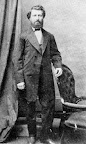
Riel (looking decidedly uncrazy at right) would wind up the spokesman and face of the many Native American grievances with Canada as it expanded. Though slightly more friendly than Americans at the time, the Canadians (particularly the English-speakers in Ontario) thought little of removing Native Americans from "their" land. Riel started in friendship, helping negotiate the Manitoba Act whereby the area acceded to the Canadian federation as a province (their equivalent of statehood).

However, Riel soon protested against the swift Anglicization of the area, as well as the near-automatic shafting of the land's first settlers. Native and White Manitobans alike loved the firebrand, voting him into Parliament three times, though hostility in the capital prevented him from ever taking his seat in Ottawa. Frontier-urban tensions boiled over as a small force led by Thomas Scott incursed into Manitoba to extend that benevolent Canadian supervision. Unhappy Métis surrounded and captured the force, eventually executing Scott. A warrant was duly issued for murder, and Mounties sent out to arrest Riel. Riel smartly skipped the border into what is now Montana.

He didn't stay in the US long, though, responding to requests from leaders of modern-day Saskatchewan to represent their concerns about the encroaching Canadian government. His entreaties utterly ignored, Riel chose direct action and employed his considerable charisma to gather a fighting force (One quote: "We are men, free and spirited men and we will not allow even the Dominion of Canada to trample on our rights"). This 1885 revolt, called the Northwest or Red River Rebellion failed, which ultimately failed as Native American rebellions tended to do. Riel surrendered to the Canadian forces and put on trial. Six white, Anglophone Protestants found him guilty but recommended mercy. The judge sentenced him to death, and Riel was hanged in November 16, 1885.

Riel's hanging was the match-strike of Quebec nationalism, which has mutated and evolved over time, but never truly gone away. The ever-sensitive Prime Minister of Canada John MacDonald announced "He shall hang, even though every dog in Quebec barks in his favour." Honoré Mercier, one the first Quebec leader to espouse nationalism, road this tide into office as Premier of Quebec shortly thereupon. Over a century later in 1995, sovereigntist member of Canadian Parliament Suzanne Tremblay (left) from Quebec sponsored a motion to repeal his conviction. The bill failed.

Oh, the crazy part? Well, Riel perceived himself increasingly in Messianic terms. Receiving an education from Jesuits, he began to identify himself with the travails of Jesus. He interrupted a sermon to begin issuing "divine pronouncements" and was eventually barred from the Catholic Church. This messages were key in gathering the troops for his failed rebellion. A jester would venture that Riel was truly the first Mormon, as he said at one point saying "Do you know these people of mine are just as were the children of Israel, a persecuted race deprived of their heritage. But I will wrest justice for them from the tyrant. I will be unto them a second David." Followers abandoned the Catholic Church widely and followed Riel into this fight in a parallel to the "Ghost Dance" movement among Lakota and other Native Americans.

Friday, December 28, 2007

Interesting People: James Traficant

How quickly we forget those wily on-the-take elected officials once the prison door is slammed. Corrupt populist princes such as "Buddy" Cianci and "Duke" Cunningham are the carnies of American democracy, colorful in nickname, style, past, and eventually, docket. But nobody holds a candle to the charmingly corrupt, entertaining James Traficant.

Traficant spent 17 years as the Democratic Congressman of the 17th district in Ohio. He always did have an air of corruption about him, but managed to evade conviction for many years (even becoming the only person thus far to beat a federal racketeering/RICO charge while defending himself.) Sadly, the toupéed one's luck ran out, and in 2002 Mr. Traficant was convicted of accepting bribes and sentenced to eight years. As with Bill Jefferson, the corrupt representative from Louisiana re-elected after investigators found $90,000 in his freezer (seriously, the freezer? If I'm hiding 90K, bloody sure it won't be that easy to find), toward the end Traficant had uncomfortable relations with party elders. These leaders were wary of being associated with this corrupt Congressman, so they generally kept their distance. Traficant responded by voting for a Republican for Speaker of the House. Also similar to Jefferson, Traficant didn't let legal problems keep him from running for office. Unbowed by pressure, Traficant would be re-elected to his seat despite public knowledge of investigations. His style extended to running for re-election while in prison as an Independent, after his conviction. Traficant finished third, with 15% of the vote.

Most memorable, however, were Traficant's brilliantly madcap speeches during "floor time", when representatives bloviate in front of an empty chamber and C-SPAN cameras for the folks back home. Some of his best lines, taken from the delightful Free James Traficant website:

"Mr. Speaker, baseball will eliminate two teams. Some surprise. Tickets average 50 bucks. A program is $10; popcorn, $5; parking, $20. A hot dog and a beer cost about $10 to $12 at most stadiums. Beam me up. The umpire said, "Play ball," not "monopoly."...I yield back what is left of America's great pastime after the greatest World Series perhaps in our history."

"Now if that is not enough to find coal in your athletic supporter, check this out: A school board in Georgia removed the word "Christmas" from their school calendar because the ACLU threatened to sue. Beam me up. If this is religious freedom, I am a fashion model for GQ...Mr. Speaker, I yield back the fact that Christmas is not about a jolly old fat man. Christmas is about the birth of Christ."

In a court hearing: "I want you to disregard all the opposing counsel has said. I think they're delusionary. I think they've had something funny for lunch in their meal, I think they should be handcuffed, chained to a fence and flogged, and all of their hearsay evidence should be thrown the hell out. And if they lie again, I'm going to go over there and kick them in the crotch. Thank you very much."

I was originally thinking of doing a post on charmingly corrupt Republican Congresspeople. Unfortunately, "charm" and "Republican Congressperson" are two terms that have no business in the same sentence, and a post on plain Republican corruption in Congress would take much too much time.

Saturday, December 15, 2007

Interesting People: Pope Benedict IX

Image Hosted by ImageShack.usHow does one pick just one Pope to focus on? You have Alexander VI, the "Borgia Pope" who was installed in 1492 and fathered four children while leader of the church. You have Pius IX, whose hand-picked prime minister was fatally stabbed in public, before angry pro-democracy protesters trapped Pius in his offices until he caved in to their demands. That doesn't even get into the crunchy legends such as Pope Joan. But for today, let's focus on Benedict IX.

What can you expect when a kid becomes Pope? Not much, even if that person becomes pope three times. Some tales have him becoming Pope at 20, others at...12. Actually, to put a finer point on it, the Catholic Encyclopedia calls him a "disgrace to the Chair of Peter. Well!

Benedict became Pope in 1032, when many Catholics were recovering from the letdown of not being Raptured/killed with the return of Jesus. At this time, the Papacy was basically a minor kingship, replete with its own troops and lands, so unsurprisingly the Chair was the subject of a great deal of maneuvering. Four years into Papacy -- about the time kids here get their learner's permits -- he was driven out of Rome by an angry mob. A friendly king re-seated Benedict, and a mob drove him off a second time.

And he came back. Decided he didn't like it, so his archpriest paid him a large sum of money to buy the Papacy from him, and became Pope Gregory VI. What was life like under Benedict IX. Accusations of homosexuality and even beastiality never went away, and he was excommunicated for simony ( selling holy offices). One future pope named him "a demon from hell in the disguise of a priest" and another named him "devoted to pleasure" according to the future Pope Victor III and then abbot.

So apparently, no matter what the current pope does, he won't even be the worst Benedict in history...

Thursday, November 29, 2007

Interesting People: The Washington Generals

During the Patriots' game last week against the Bills, a commentator compared the Pats to the Globetrotters and the rest of the league minus the Colts (and apparently the Eagles) to the "Washington Generals". Who are these people?

The Generals were the traveling team that would face the slapstick basketball team Harlem Globetrotters in their exhibition games. They weren't based in Washington anymore than the Globetrotters were in Harlem -- that was just their name. They were the Moe to the Globetrotters' Curly (except Curly wins all the time). The Globetrotters had great amounts of skill, no doubt, but much of their routine consisted of clowning – spinning the ball on the opponents' heads, drop kicking toward the basket, even eating a fake ball made of pumpernickel. I remember Generals getting pantsed out on the floor (though their website declares that all games are indeed real competitive matches).

Their only cognates in the sports world are the interchangeable no-name wrestlers who lose to the big acts in pro wrestling, and even they don't have as bad a deal. Imagine that you're losing not just once in a while, but every almost night. Losing bigtime, and without much dignity left over. Granted, the staging isn't as meticulous as in a wrestling match, but still…

Plus...plus...you gotta act. Not only was the Generals' job to highlight the Globetrotters' comedy by playing straight basketball, and to have a pretension of competition in the match, but ya gotta act. The eightieth time that Meadowlark Lemon shoots a foul shot, but *snap* the ball comes back on elastics, you have to act surprised. Then you have to act a little upset that the refs don't call the violation, but not too upset. You have to be a good sport. By the ninetieth time the crowd starts laughing at me because a Globetrotter made me look like a fool, I'd be tempted to sock one of 'em.

Being a General means an hour of hustling, and then being forgotten. You're an extra in a comedy, except you're on-screen for the whole movie. Nobody knows who you are, but you're expected to give it all and leave it on the floor. How do you end up in such a career?

Some interesting stuff about the Washington Generals from various sources:

  • The Generals were incorporated separately from the Globetrotters, so were strictly never under the same controlling interest – they could have gone their separate ways if they so desired.
  • Early on, Globetrotters' opponents would merely change uniforms from town to town, appearing to be five different teams when they were just five sets of laundry.
  • They were one of the earliest professional teams to have a woman player. For example, sometime actress Nancy Lieberman was a General.
  • In the 50s and 60s, the Generals would actually have a real shot (see below). All the clowning does mean the Globetrotters do pass up some good shots, and it would catch up with them. In the early days, the Generals played to win and not a few times, fans didn't get much of a comedy show.
  • In 1962, the Generals beat the Globetrotters.


The Generals were traded in for the "New York Nationals": same owner (Red Klotz), new laundry.

Profile of Generals' owner Red Klotz

Friday, November 16, 2007

Interesting People: Gulbuddin Hekmatyar

From time to time, I'll do a post in the category "Interesting People". These will mainly be people who got a flare of media attention, then burned out. But their story is still fascinating and may even be ongoing still. I find such people interesting because of the extremes of human experience they plumb. See how that all works?

The "interesting person" of the moment is Gulbuddin Hekmatyar, and his extreme is survival. In his lifetime, Hekmatyar has counted Iran, Pakistan, the Taliban, and the United States as allies at different times. Naturally he lives in Afghanistan, where he was prime minister on two different occasions and was a murderer at 25. Ronald Reagan called him a "Founding Father" of Afghanistan. A good introductory biography of him can be found here, though it ends before the current era in Afghanistan.

Briefly, Hekmatyar is a warlord of the classic mold, controlling a heroin-fueled empire in Western Afghanistan. He sided with the United States after the Soviet invasion of Afghanistan. Later, he would work with Pakistan to push the Taliban into power. When the Taliban were on the run, he resumed his middle stance. Just this week, American troops were active in his region. Though not fighting against us, Hekmatyar is apparently feeling quite bold lately. Frankly, I don't care what Bush or CNN say -- if Hekmatyar is heading toward a more active role, this says volumes about our current position in the region. While he was never an ally of the United States, he always held back from direct confrontation. That may be changing.

In a country were battle fatalities and assassinations are common ways of dying, this man is on his third or fourth war. He switches sides like a drunk American at a FIFA soccer match, and even after being designated a "global terrorist" by the American government, he's still at large. Hekmatyar could write a book about "surviving in the corporate war zone" and make a bundle.