
The most poisonous thing in a democratic society may well be doubt. George W Bush's legacy was tarnished from the get-go by the narrow, questionable winning margin in Florida that provided his victory in the 2000 election. More recently, the thin spread of the 2008 Senatorial election in Minnesota is being used by a desperate Republican campaign to keep a legitimately elected senator from being seated. The Minnesota Republicans will clearly try to keep the doubt of Senator Franken's margin of victory alive with a view toward his re-election. The first move of losers in many democratic elections in developing countries is to throw doubt on the election apparatus. Losing sucks but at least you know where everyone stands and can move on, whereas doubt never goes away.
Doubt can be poisonous...and that's when they count the votes.
The most critical juncture of yesterday's Democratic State Convention was a vote on continued usage of the current platform (described to me by Deval's former campaign spokesperson as "a 45-page document nobody reads") in place of the abominable proposed replacement. About 1 out of 6 delegates signed this amendment, nevermind supported it. The whole morass was incredibly dense anyway; I had a 10-minute conversation with one of the smartest members of the Legislature to explain what was going on, and I'm not sure we even got to clarity. Anyway, as per normal procedure, a voice vote was taken on the amendment.
The Chair of the convention was John Walsh, a man who sought such a bland document from day one. He declared the motion denied and went on to other business immediately. Almost instantly, calls to question the vote arose and were ignored. In the hall, the sergeant-at-arms refused to give me the microphone to say "doubt the chair" -- the words Walsh himself had told us to use in order to question the a voice vote. Online, well, you can read for yourself.
Now, I think the amendment did fail. I do think that my side lost. from what I heard. But I'll never know. I'll never know because in the interest of saving the 20 seconds he'd have needed for delegates to stand or raise their hands, Walsh immediately went on to the next piece of business.
It's odd, because we dwelt for a couple of minutes on a non-binding resolution on slot machines later that day. Walsh wanted to get that non-binding resolution right, but was far less meticulous about the entire raison d'être of yesterday's confab. It's odd because a couple hours later on the fathers' rights amendment, Walsh told the hall how easily some very loud "no" voices can be overrepresented in a voice vote. He evidently knew how misleading voice votes can be, but did what he wanted anyhow.
Chairman Walsh ran a fairer convention that his predecessor ever did. But his decision to save 20 seconds by grace of his own impressions comes at the expense of the legitimacy of the vote. The pivotal decision of the 2009 convention is tarnished, and our platform for the next two years will be as well -- all because asking the delegates to stand would have been too much bother.
This is how I see it as somebody who felt that a fair count would have been against us. For the several hundred somebodies in that hall who feel differently -- it feels like it's 2005 all over again.
As for the future, it's easy to see talk about amending the rules to mandate standing or hadn counts of delegates from now on. However, given that the Sergeant-of-arms did not obey the rules for this current convention (on doubting the chair, or suspension to let David Plouffe speak), I don't see the point of writing new rules if they won't be kept in good faith anyway.
PS: I am not ignoring the hard work of the education team to gather 160 signatures on the MCAS amendment despite no organization or budget backing us. The work we did at the convention is just the start, and I'm hoping to keep up our momentum in making the Democratic Party seriously think about education despite itself...more on that later.
Showing posts with label convention. Show all posts
Showing posts with label convention. Show all posts
Sunday, June 7, 2009

Saturday, August 30, 2008
Fessing up: I like national conventions
One doesn't have to look that far to find people bemoaning the massive spectacle that is the national political convention. This post was inspired by one recent conversation at my second blogging home at BlueMassGroup. But I'll admit that I like conventions. I hung around the 2004 gathering in Boston, and have attended every Democratic state convention for the past several years. Here's why:
First off, one common complaint is that such a large amount of money is being wasted. Well, NASCAR strikes me as a waste of money, too -- people driving large machines in circles is a billion-dollar industry. But heck, it isn't my money so I don't really care. Same deal on national political conventions. It's not really my money that's being wasted...it's the money of the big-ticket donors to the parties. Sure, one can complain about the easy access of corporate suitors to politicians, but that isn't really the dominant argument. So if the Republicans and Democrats want to blow tons of money into putting on a show, go right ahead.
Secondly, I do love a show. I have no grudge against the feting of men and women who can throw a ball or swing a bat, but if they get such adoration, why not offer a little of the same every four years to people who will be spending our money, and making life-and-death decisions on a daily basis? The Opening Ceremony has no real significance to the athletic competitions, but is an inspiring spectacle. It is a key part of the Olympic experience, as the conventions are a key part of the political experience in our country. It's emotional to see Teddy up there, knowing this will likely be his last convention as Senator. I like pageantry, and I mention later on, it is a key part to raising consciousness and excitement about politics in this country.
Thirdly, I think that there is something important that happens at the state and national conventions. The kind of cross-fertilization of activists and politicians from across the country is important to exchange ideas and foster a feeling of community within the party and the country. Robert Putnam isn't the only one to note the gradual fading of American community, and that includes a sense of political community. This line of work that has such a direct impact on the American quality of life is held in such disrepute by Americans -- politics is universally seen as bad. Conventions give Mario Cuomo, Ann Richards, and Brian Schweitzer -- and Barack Obama -- platforms before audiences across America, establishing common touchstones in America that wouldn't otherwise be known. I've blogged in the past of the disastrous state of Belgium because there is no truly national political conversation, and these shows are a key part in avoiding the same fate in our nation.
If we can give over endless hours of primetime to a glorified singing contest that emphasizes the worst of the worst, to watching a parade of men hit a small white ball and wander off after it, to the solving of grotesque fictional crimes in all its gory forensic detail, we can bloody well examine and celebrate the machinery of American democracy. Politics should be seen as honorable and exciting again, and the conventions are part of approaching that change.
Fourthly, politics is a subject about which Americans are pretty ignorant. Take the example of the recent poll wherein 1% of respondents said they thought that Obama was Jewish. Americans are clueless about where things are in the Middle East, and are seemingly ready to give away the Bill of Rights as they don't know what's in it.
If it takes endless stagecraft, bad cover songs, dozens of speeches, and funny hats by the hundreds to hit Americans over the head until they come to understand the broad outlines of the American political scene, so be it. They may be excessive and strictly speaking not necessary to political process, but it is one of the few remaining keys to American political community -- and that I think makes them a good thing. Besides, you can always change the channel.
Friday, February 15, 2008
Delegate math updated
I continue with my obsession as the numbers of pledged delegates outstanding diminishes. Despite the media hype, the window for Obama to clinch the nomination without superdelegate backing is getting narrower.
Using the CNN numbers and barring significant change in superdelegate alignment, we have:
Total delegates: 4,049
Total pledged delegates: 3,253
Pledged delegates not yet contested: 1,147 (35.2%)
Delegates required to win: 2,025
Obama delegates (incl. pledged supers): 1262, 763 req'd.
Clinton delegates (incl. pledged supers): 1213, 812 req'd.
To win on just current superdelegates and remaining pledged delegates, Obama would need 66.5% of the remaining pledged delegates, and Clinton 70.1%
Whether it comes down to their abstention, bullying, or independent choice, the superdelegates are going to have a major role in this process.
Wednesday, February 13, 2008
Not-so-usual suspects
Back in the day, all us political junkies were crying foul about the compressed schedule: "Iowa, New Hampshire, and maybe Nevada will decide the nomination!" we said, "by the time those small states are done, we'll have a clear frontrunner! With about 1% of the population having voted, the choice would effectively be made by our ADHD media." Heh...good times, good times.
Fast forward a bit. Remember how this sucker was tied after Super Tuesday? The day when, as somebody put it "an irresistible force will meet an unmovable object". So the only normal thing in such circumstances came about: almost a dead-even split. Wow! Two great candidates in almost a perfect tie!
Sooooo....after surprising wins in Washington, Maine, and Virginia, what do we hear?* That Obama is the frontrunner, almost guaranteed to win this thing. There are already people whining that Hillary should get out of the race...because she's trailing by a whopping 50.3%-48.6% of delegates committed with over a third of them still to be decided.
I figured a few contests in small states would give the media their frontrunner, even though such nomenclature would short-circuit the democratic process. I didn't think those states would turn out to be Maine, Washington, and Virginia.
*No, Obamaites, Maryland and Louisiana weren't surprising wins.
Saturday, February 9, 2008
What would a brokered convention look like? Part III
This is the part III of a four-part series on what a brokered convention would look like. (Part I, an introduction to the concept, is here, and Part II, a case study of the 2006 Liberal Party convention of Canada, is here). This part explores the likelihood of a brokered convention this year. The final part (posted next weekend) will explore how it could unfold.
At this point, we can lop off some hypotheticals that were in play when this series started:
At the outset, I thought a brokered convention could most likely happen because three strong candidates would last deep into the season. As we know, however, John Edwards and Mitt Romney didn't catch fire. Edwards supposedly will go into Denver controlling 26 of the 4049 delegates. However, that is an estimate. The January event in Iowa merely elected delegates from the precinct level to upcoming county, then state conventions. With Edwards out of the race, those early-stage delegates could end up deciding to throw in with a remaining candidate. In other words, Edwards may go into Denver with even less than the .64% of the delegates that he already has.
The greatest likelihood for a brokered convention is thus the following scenario:
To examine each precondition in turn:
Neither candidate has enough pledged delegates to win nomination without relying on ex-officio "superdelegates";
I have argued that neither Clinton nor Obama will enter into the convention with an absolute majority of delegates.
Given that most delegates from here on in (in Virginia, Pennsylvania, Ohio, and Texas) will be awarded in equitable primaries rather than loathsome caucuses, it is difficult to imagine Clinton or Obama harvesting over 62% of the remaining delegates who are tied to primary or caucus results. These pledged delegates make up only 80% of the votes at the Democratic Convention in Denver. The other 20% are functionaries and elected officials who are so-called "super-delegates".
I am presuming in this analysis that any attempt to seat the (overwhelmingly pro-Hillary) delegates from Michigan and Florida would fail. Obama's delegates would vote against, and would reach a majority with the help of party functionaries looking to enforce the rules that those states flouted.
Unless either of them wins over 62% of the remaining delegates, they will enter short of the necessary number. Given the closeness of primaries thus far, and the startling demographic polarization of the process this year by race, gender, income, and age, I rate this precondition likely.
There is enough tension or vagueness about the superdelegates' role that no one candidate has an overwhelming number of them.
While some superdelegates have voluntarily tied their vote to that of their state or district (CA Senator Barbara Boxer is one), most others such as Senators Kerry and Kennedy have not. There are 796 of these superdelegates, and 354 have publicly committed. About 60% of those (234) have committed to Hillary.
While superdelegates can change their mind at will, they need a good reason to do so. The idea of changing one's commitments makes one untrustworthy in the eyes of all...if you're going to just blow with the wind, how much is your support really worth? Keeping in mind that most of these people are either chairs or vice-chairs of state parties or elected officials, that is not a decision to be taken lightly at all. (Genghis Khan once killed an enemy soldier for failing to show proper loyalty when he offered to betray his commander. The same principle would apply here, and the punishment is political death).
Though Obama's recent promotion to frontrunner may garner him more superdelegates, we can expect that those people will be roughly evenly split. Even if Obama continues to score well, though, remember that many of these functionaries came into power under Bill Clinton and also value partisan loyalty. For that reason, Hillary will likely be overrrepresented among them.
Furthermore, the fact that these superdelegates corrode the democratic sheen of the nominee selection process is clearly discomforting to many of them. Donna Brazile, a voluble CNN talking head, has commented on this. Indeed, superdelegates explicitly tying ones vote to popular will indicates this feeling is widespread ( MN Rep. Tim Walz is another example).
For a brokered convention to happen at all, there must be a "third option" that takes enough of a bite that an evenly split remainder can't reach 50%. Given Edwards has 26 delegates, the most likely addition to that would be votes from superdelegates not ready to put Obama or Hillary over the top for these reasons. A dozen votes of "uncommitted" or a symbolic choice such as Al Gore or John Edwards would do the job. Then the chaos sets in. It is conceivable that a dozen or so superdelegates not wanting to be the ones who short-circuit the democracy of the process would choose this option.
This discomfort and division may well leave superdelegates' status and role up in the air as we come to convention. I rate the chance of this precondition existing as somewhat likely.
The final essential provision for a Democratic brokered convention is this: No deal has been struck
The final event on the nomination calendar is the Puerto Rico caucus on June 8th. The final major event is the May 20th Oregon primary. The Democratic National Convention opens on August 25th. That gives us 78 days before the convention starts during which we'll have nearly precise delegate counts.
Conventional (ha!) wisdom says that a brokered convention would be exciting, and bad for the party. As DNC chair and godlike human Howard Dean said,:
Obama and Clinton have strengths in different states, and on different issues. They have different surrogates. A presidential campaign is a massive and expensive undertaking, and requires time to get going. If we don't have a nominee until late August, it will be too late. Furthermore, winning at a brokered convention will mean that somebody got the nomination through working the process. There will be many hard feelings to heal, and some of them won't heal.
The Democratic Party knows that. The eminences grises of the party -- Howard Dean, Al Gore, George Mitchell, Dick Gephardt, Jimmy Carter -- know that. The overwhelming interest of the party and its members is to make a deal. To use a phrase we'll be hearing more and more, to "lock Hillary and Obama in a room, and leave them there until a deal is done." While passionate supporters would be let down, such a deal would make reconciliation easier.
While I don't know what such a deal would look like (but interesting speculation can be found here). At the end of the day, though, these two are professionals. Obama is still young, and Hillary Clinton isn't past her due date either. Bullishly continuing would make many enemies in Congress and in the party, all for a severely reduced chance at winning in November. I think at some point they make the deal. So, to review:
For a brokered Democratic convention, we need:
-Neither candidate with enough pledged delegates to reach the 2,025 mark - LIKELY;
-Sufficient tension or vagueness about the superdelegates' role so their disposition is unsure - SOMEWHAT LIKELY
-No deal has been struck - UNLIKELY
All told, I would set the odds of a brokered convention at 1 out of 3 because I would expect a compromise to be found in June or July. However, I could well be wrong. Next week, I game out the scenario for such a brokered convention in Denver Debacle: Democrats Divided.
At this point, we can lop off some hypotheticals that were in play when this series started:
- The Republicans will not have a brokered convention, unless John McCain dies in the next six months. I can't imagine that Mike Huckabee will dominate all the contests until the end of the season, then team up with Mitt Romney and Ron Paul to torpedo McCain at the convention. I'd love it, but don't think it will happen.
- The Democrats will have a nominee with a majority of pledged delegates.
At the outset, I thought a brokered convention could most likely happen because three strong candidates would last deep into the season. As we know, however, John Edwards and Mitt Romney didn't catch fire. Edwards supposedly will go into Denver controlling 26 of the 4049 delegates. However, that is an estimate. The January event in Iowa merely elected delegates from the precinct level to upcoming county, then state conventions. With Edwards out of the race, those early-stage delegates could end up deciding to throw in with a remaining candidate. In other words, Edwards may go into Denver with even less than the .64% of the delegates that he already has.
The greatest likelihood for a brokered convention is thus the following scenario:
- Neither candidate has enough pledged delegates to win nomination without relying on ex-officio "superdelegates";
- There is enough tension or vagueness about the superdelegates' role that no one candidate has an overwhelming number of them;
- No deal has been struck.
To examine each precondition in turn:
Neither candidate has enough pledged delegates to win nomination without relying on ex-officio "superdelegates";
I have argued that neither Clinton nor Obama will enter into the convention with an absolute majority of delegates.
Given that most delegates from here on in (in Virginia, Pennsylvania, Ohio, and Texas) will be awarded in equitable primaries rather than loathsome caucuses, it is difficult to imagine Clinton or Obama harvesting over 62% of the remaining delegates who are tied to primary or caucus results. These pledged delegates make up only 80% of the votes at the Democratic Convention in Denver. The other 20% are functionaries and elected officials who are so-called "super-delegates".
I am presuming in this analysis that any attempt to seat the (overwhelmingly pro-Hillary) delegates from Michigan and Florida would fail. Obama's delegates would vote against, and would reach a majority with the help of party functionaries looking to enforce the rules that those states flouted.
Unless either of them wins over 62% of the remaining delegates, they will enter short of the necessary number. Given the closeness of primaries thus far, and the startling demographic polarization of the process this year by race, gender, income, and age, I rate this precondition likely.
There is enough tension or vagueness about the superdelegates' role that no one candidate has an overwhelming number of them.
While some superdelegates have voluntarily tied their vote to that of their state or district (CA Senator Barbara Boxer is one), most others such as Senators Kerry and Kennedy have not. There are 796 of these superdelegates, and 354 have publicly committed. About 60% of those (234) have committed to Hillary.
While superdelegates can change their mind at will, they need a good reason to do so. The idea of changing one's commitments makes one untrustworthy in the eyes of all...if you're going to just blow with the wind, how much is your support really worth? Keeping in mind that most of these people are either chairs or vice-chairs of state parties or elected officials, that is not a decision to be taken lightly at all. (Genghis Khan once killed an enemy soldier for failing to show proper loyalty when he offered to betray his commander. The same principle would apply here, and the punishment is political death).
Though Obama's recent promotion to frontrunner may garner him more superdelegates, we can expect that those people will be roughly evenly split. Even if Obama continues to score well, though, remember that many of these functionaries came into power under Bill Clinton and also value partisan loyalty. For that reason, Hillary will likely be overrrepresented among them.
Furthermore, the fact that these superdelegates corrode the democratic sheen of the nominee selection process is clearly discomforting to many of them. Donna Brazile, a voluble CNN talking head, has commented on this. Indeed, superdelegates explicitly tying ones vote to popular will indicates this feeling is widespread ( MN Rep. Tim Walz is another example).
For a brokered convention to happen at all, there must be a "third option" that takes enough of a bite that an evenly split remainder can't reach 50%. Given Edwards has 26 delegates, the most likely addition to that would be votes from superdelegates not ready to put Obama or Hillary over the top for these reasons. A dozen votes of "uncommitted" or a symbolic choice such as Al Gore or John Edwards would do the job. Then the chaos sets in. It is conceivable that a dozen or so superdelegates not wanting to be the ones who short-circuit the democracy of the process would choose this option.
This discomfort and division may well leave superdelegates' status and role up in the air as we come to convention. I rate the chance of this precondition existing as somewhat likely.
The final essential provision for a Democratic brokered convention is this: No deal has been struck
The final event on the nomination calendar is the Puerto Rico caucus on June 8th. The final major event is the May 20th Oregon primary. The Democratic National Convention opens on August 25th. That gives us 78 days before the convention starts during which we'll have nearly precise delegate counts.
Conventional (ha!) wisdom says that a brokered convention would be exciting, and bad for the party. As DNC chair and godlike human Howard Dean said,:
The idea that we can afford to have a big fight at the convention and then win the race in the next eight weeks, I think, is not a good scenario.
I think we will have a nominee sometime in the middle of March or April. But if we don't, then we're going to have to get the candidates together and make some kind of an arrangement, because I don't think we can afford to have a brokered convention -- that would not be good news for either party
Obama and Clinton have strengths in different states, and on different issues. They have different surrogates. A presidential campaign is a massive and expensive undertaking, and requires time to get going. If we don't have a nominee until late August, it will be too late. Furthermore, winning at a brokered convention will mean that somebody got the nomination through working the process. There will be many hard feelings to heal, and some of them won't heal.
The Democratic Party knows that. The eminences grises of the party -- Howard Dean, Al Gore, George Mitchell, Dick Gephardt, Jimmy Carter -- know that. The overwhelming interest of the party and its members is to make a deal. To use a phrase we'll be hearing more and more, to "lock Hillary and Obama in a room, and leave them there until a deal is done." While passionate supporters would be let down, such a deal would make reconciliation easier.
While I don't know what such a deal would look like (but interesting speculation can be found here). At the end of the day, though, these two are professionals. Obama is still young, and Hillary Clinton isn't past her due date either. Bullishly continuing would make many enemies in Congress and in the party, all for a severely reduced chance at winning in November. I think at some point they make the deal. So, to review:
For a brokered Democratic convention, we need:
-Neither candidate with enough pledged delegates to reach the 2,025 mark - LIKELY;
-Sufficient tension or vagueness about the superdelegates' role so their disposition is unsure - SOMEWHAT LIKELY
-No deal has been struck - UNLIKELY
All told, I would set the odds of a brokered convention at 1 out of 3 because I would expect a compromise to be found in June or July. However, I could well be wrong. Next week, I game out the scenario for such a brokered convention in Denver Debacle: Democrats Divided.
Thursday, February 7, 2008
It's all about superdelegates
The capsule summary is this: the winner of the Democratic National Convention will have to win by capturing a notable segment of elected Democratic officials and party functionaries. These ex-officio or "Superdelegates" make up 20% of the votes at the convention.
Don't believe me? Well, including projected totals in California and New Mexico (which are still coming in) and including the 1/3 of the superdelegates who've aligned themselves with a candidate...
Obama would need over 67% of pledged delegates to win the nomination without gaining additional superdelegates. Due to her lead in superdelegates, Hillary would need to score a mere 62%. In other words, not gonna happen...
After the craziness of Super Tuesday, here's what we know (or think we know):
Here's where the numbers come from:
So Hillary needs 1,039 delegates to secure the nomination. Obama need 1,126. There are 1,673 remaining pledged delegates gained through primaries and caucuses.
Even with 60% of the vote, Hillary Clinton cannot win the nomination without capturing at least 49 more "superdelegates".
It is ridiculous to think after this campaign that Hillary or Obama are going to capture 60% of the remaining vote. But we are in a zone right now where it all comes down to superdelegates. It does not come down to the remaining voters, but to who captures these elected officials or party functionaries.
I'm not saying that I like it, but I am saying that's what it is.
PS: My "what would a brokered convention look like" series will resume on Sunday.
Don't believe me? Well, including projected totals in California and New Mexico (which are still coming in) and including the 1/3 of the superdelegates who've aligned themselves with a candidate...
Obama would need over 67% of pledged delegates to win the nomination without gaining additional superdelegates. Due to her lead in superdelegates, Hillary would need to score a mere 62%. In other words, not gonna happen...
After the craziness of Super Tuesday, here's what we know (or think we know):
- According to the CNN pledged delegate tracker on MyDD, Obama has 635 pledged delegates to Clinton's 630.
- This does not include NM and CA, who are still counting theirs. It is reasonable to assume once those two states are apportioned, Hillary will and Obama will each have about 790 pledged delegates. If anything, Hillary's narrow win in California may make the numbers 800-780.
- It takes 2,025 votes to win the Democratic nomination.
- Of the 4,049 delegates at the convention, 3,253 will be pledged.
- On Super Tuesday, the candidates essentially split the vote on Super Tuesday.
- While Obama is out-raising Hillary, she isn't as poorly off as some Obamamites want to think..
- Despite the expectations game, neither Hillary or Obama are likely to dip below 40% in the near future.
- Gallup's tracking poll is showing that Obama's momentum has stalled.
We also know that:
Here's where the numbers come from:
| Scenario | Clinton dgs. | Obama dgs. | Remaining dgs |
| Current | 790+193=986 | 790+106=896 | 1673+497=2170 |
So Hillary needs 1,039 delegates to secure the nomination. Obama need 1,126. There are 1,673 remaining pledged delegates gained through primaries and caucuses.
Even with 60% of the vote, Hillary Clinton cannot win the nomination without capturing at least 49 more "superdelegates".
It is ridiculous to think after this campaign that Hillary or Obama are going to capture 60% of the remaining vote. But we are in a zone right now where it all comes down to superdelegates. It does not come down to the remaining voters, but to who captures these elected officials or party functionaries.
I'm not saying that I like it, but I am saying that's what it is.
PS: My "what would a brokered convention look like" series will resume on Sunday.
Monday, January 21, 2008
What would a brokered convention look like? Part I
If there's any idea that can make a political analyst shudder with sinful pleasure (aside from a no-strings attached grant), it's the idea of a brokered political convention. Today I'm starting a 4-part series on what a brokered convention may look like in 2008:
Part I: What is a brokered convention? Past examples
Part II: A brokered national convention in action: December 2006
Part III: Possibilities for this year
Part IV: Denver Debacle: Democrats Divided
A "brokered" convention is one in which no candidate possesses a majority of delegates going into the convention, meaning that the candidate selection will not be automatic. Since the 1980s, the convention has been an elaborately staged coronation, with delegates voting in the winner through a largely pro forma exercise. Media folks, who always whine about how meaningless conventions are, openly pine for a convention with a "floor fight" wherein candidates attempt to assemble a majority through an orgy of deal-making, pressure, and all-out political hustling. We may see such a scene before us again.
The last time there was a convention with any sense of drama in the United States was in 1980, when Democrat Ted Kennedy was seeking to undermine incumbent President Jimmy Carter. Carter possessed a majority of delegates, but was clearly headed for a loss to Ronald Reagan. Attempts by the Kennedy foes to change the rules freeing all delegates to vote their conscience failed (excellent details here.)
One can also examine the Green Party convention of 2004 in Milwaukee. The result was unclear going in, because delegates could choose between eventual nominee David Cobb or "uncommitted", leaving the door open for Ralph Nader to run as their nominee. With Nader characteristically prevaricating on the question, Cobb won on the third ballot with 408 of 769 votes. Although a national convention, the low Green delegate count (held in a room that called to mind the regional awards of Amway) stripped out most of the theatrics that make a major brokered convention such a scene. For a vague idea, you can always check out the episode of The West Wing called "2162 votes" about a fictional brokered convention of the Democratic Party.
 Before that, you have to go back to '52 when the Democrats needed three rounds of balloting to choose sacrificial lamb Adlai Stevenson over Estes Kefauver. Stevenson would go on to be slaughtered by General Eisenhower, and enjoy it so much that he repeated his massive loss four years later.
In recent times, a frontrunner has emerged in either party early on in the process. There have been early contests with more than one figure, though it winnows quickly. (Since the 1960s, Iowa and New Hampshire have picked the eventual winner less than half the time, and that streak will continue in 2008.) The money to keep going will often unite behind a particular candidate, especially as the game changes from retail politics in small states to relying on advertisements and message. Although Jesse Jackson in 1988 and John McCain in 2000 made decent runs at it, their campaigns eventually faded before Dukakis and Bush.
One reason for these failures was the extended nomination schedule. By the time the really big states such as California and New York had swung in, the party had generally united around one candidate over the course of the previous primaries and caucuses. Jackson won Michigan, but lost most everything else by the time the big states had their voice. These larger states -- with larger delegate counts -- put a rubber stamp on the choice, providing the delegates that gave candidates the majority.
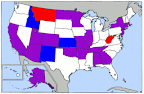
However, this year the field remains divided on the Republican side and to an extent on the Democratic side. When the big states vote on "MegaTuesday", February 5th, there is an excellent chance that more than one candidate will emerge with many delegates. All the states in this map are voting on that day (purple indicates both parties vote that day). With enough money, they could push this thing all the way to the convention.
But more about that in Part III. Next part, I want to examine a national convention from just over a year ago. This convention was brokered, and a shrewd operator entered in third place, and left in first.
Part I: What is a brokered convention? Past examples
Part II: A brokered national convention in action: December 2006
Part III: Possibilities for this year
Part IV: Denver Debacle: Democrats Divided
A "brokered" convention is one in which no candidate possesses a majority of delegates going into the convention, meaning that the candidate selection will not be automatic. Since the 1980s, the convention has been an elaborately staged coronation, with delegates voting in the winner through a largely pro forma exercise. Media folks, who always whine about how meaningless conventions are, openly pine for a convention with a "floor fight" wherein candidates attempt to assemble a majority through an orgy of deal-making, pressure, and all-out political hustling. We may see such a scene before us again.
The last time there was a convention with any sense of drama in the United States was in 1980, when Democrat Ted Kennedy was seeking to undermine incumbent President Jimmy Carter. Carter possessed a majority of delegates, but was clearly headed for a loss to Ronald Reagan. Attempts by the Kennedy foes to change the rules freeing all delegates to vote their conscience failed (excellent details here.)
One can also examine the Green Party convention of 2004 in Milwaukee. The result was unclear going in, because delegates could choose between eventual nominee David Cobb or "uncommitted", leaving the door open for Ralph Nader to run as their nominee. With Nader characteristically prevaricating on the question, Cobb won on the third ballot with 408 of 769 votes. Although a national convention, the low Green delegate count (held in a room that called to mind the regional awards of Amway) stripped out most of the theatrics that make a major brokered convention such a scene. For a vague idea, you can always check out the episode of The West Wing called "2162 votes" about a fictional brokered convention of the Democratic Party.
Before that, you have to go back to '52 when the Democrats needed three rounds of balloting to choose sacrificial lamb Adlai Stevenson over Estes Kefauver. Stevenson would go on to be slaughtered by General Eisenhower, and enjoy it so much that he repeated his massive loss four years later. In recent times, a frontrunner has emerged in either party early on in the process. There have been early contests with more than one figure, though it winnows quickly. (Since the 1960s, Iowa and New Hampshire have picked the eventual winner less than half the time, and that streak will continue in 2008.) The money to keep going will often unite behind a particular candidate, especially as the game changes from retail politics in small states to relying on advertisements and message. Although Jesse Jackson in 1988 and John McCain in 2000 made decent runs at it, their campaigns eventually faded before Dukakis and Bush.
One reason for these failures was the extended nomination schedule. By the time the really big states such as California and New York had swung in, the party had generally united around one candidate over the course of the previous primaries and caucuses. Jackson won Michigan, but lost most everything else by the time the big states had their voice. These larger states -- with larger delegate counts -- put a rubber stamp on the choice, providing the delegates that gave candidates the majority.
However, this year the field remains divided on the Republican side and to an extent on the Democratic side. When the big states vote on "MegaTuesday", February 5th, there is an excellent chance that more than one candidate will emerge with many delegates. All the states in this map are voting on that day (purple indicates both parties vote that day). With enough money, they could push this thing all the way to the convention.
But more about that in Part III. Next part, I want to examine a national convention from just over a year ago. This convention was brokered, and a shrewd operator entered in third place, and left in first.
Subscribe to:
Posts (Atom)
